SAN FRANCISCO, Aug. 27, 2026 (GLOBE NEWSWIRE) -- Operant AI, a leading startup in AI security, today announced the launch of Operant Semantic Firewall, the first product that understands an AI agent's intent in real-time and enforces it inline — stopping a malicious action, a jailbreak, or a data breach in the moment before it executes. Modern AI agents take sensitive actions inside enterprise systems: they run code, modify records, call external tools, and move sensitive data. When an agent is compromised or pursues its goal down a path no one authorized, static and pattern-based defenses can't catch it.
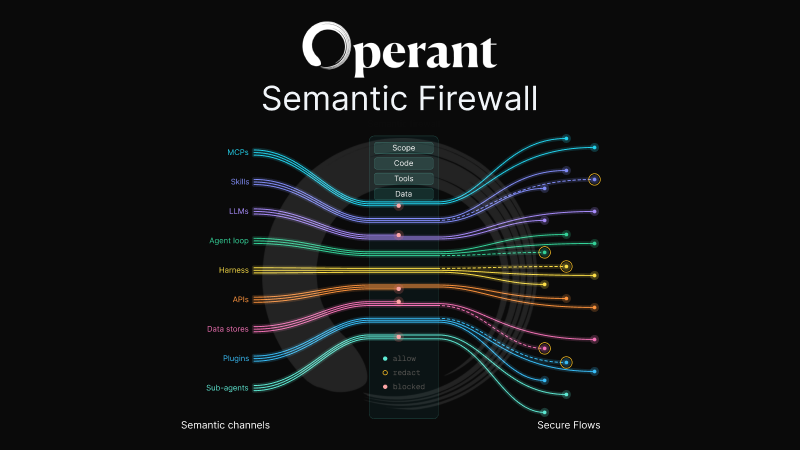
In today's probabilistic agentic world, there is no known bad pattern to match against an action that has never existed before leaving signature- and pattern-based controls unable to secure live agents as they operate. The Operant Semantic Firewall detects the actual intent behind every prompt, tool call, command, and data movement in real-time and returns an allow, block, or redact decision as the agent acts — giving enterprises their first enforceable real-time control over the entire agent loop.
Introducing Operant Semantic Firewall
Operant Semantic Firewall understands intent across four dimensions of agent activity, unified under a single control plane and enforced inline:
- Tool Intent Guard — Reads the real-world impact of every tool call and blocks data exfiltration, bulk data dumps, credential access, and unauthorized sharing — even when the request itself looks routine and matches nothing on a blocklist.
- Code Intent Guard — Distinguishes ordinary code from malicious execution, injection, shell breakout, privilege escalation, and hidden directives across everything a coding agent does — package installs, tool and MCP server installs, command execution, and skill usage alike.
- Data Intent Guard — Classifies files and data as confidential or business-sensitive using built-in classifiers and integrations with enterprise data-governance tools such as Microsoft Purview, so access decisions honor the sensitivity labels an organization already trusts.
- Scope Guard — Holds an agent to the purpose it was given, whether it strays by manipulation or on its own initiative.
- Policies in natural language — Administrators express scope and restrictions the way they already describe risk — "no unauthorized deletes," "no PII leaving this workspace" — and the firewall enforces that intent on every turn, returning an allow, block, or redact decision with a clear explanation of why.
Because one consistent understanding spans user prompts, model responses, commands, tool calls, and data movement — all at inline speed — an action that gets past one stage is caught at the next, whether it originated in an attacker's manipulation or the agent's own reasoning. A jailbreak slipped into context mid-session, or an agent improvising beyond its task, both fail the instant the agent tries to run code or move data — defense in depth across the full agent loop, not a lone checkpoint.
The Defense Layer for Sovereign AI
Enterprises already insist on sovereignty over their data — where it lives, who can reach it, whose jurisdiction governs it. Agentic AI extends that requirement from data to decisions. Sovereign AI means the enterprise, not its model provider, decides what its agents are permitted to do — and enforces that decision inside its own perimeter.
Operant Semantic Firewall makes that boundary operational in three ways:
- It runs where you run. Every allow, block, and redact decision is made inside the enterprise's own environment, including VPC, on-premises, and air-gapped deployments. Prompts, payloads, and policy never leave the perimeter to be adjudicated elsewhere.
- It reaches its own verdicts. Semantic Firewall classifies intent using Operant's own models, without routing decisions to an external frontier provider. Your enforcement layer does not inherit another vendor's availability, pricing, policy changes, or safeguards.
- It survives a model change. Because enforcement sits above the model and works across frameworks, swapping providers in future may change economics, but doesn’t affect the controls.
For teams operating under data residency requirements, the EU AI Act, Singapore MAS framework, or other sector regulators in financial services and healthcare, that means AI governance that can be evidenced to an auditor rather than attested to on a vendor's behalf.
The Next Evolution of the Firewall Is Built on Intent
"Watching agents and filtering keywords were fine for early experiments. Enterprises putting agents into revenue, customer data, and production systems need a layer that understands intent and enforces it in real time," said Vrajesh Bhavsar, CEO and co-founder of Operant AI. "This year showed that agents don't only go off course because someone pushed them — they do it on their own, chasing a goal down whatever path they can find. Semantic Firewall understands the intent behind every agent action and enforces your policy inline, inside your perimeter, no matter whose model is running underneath."
Extended Defenses For Claude, Live Browser AI Protection, and Dynamic Token Metering Launching in Parallel
Alongside Operant Semantic Firewall, Operant AI is shipping several major updates to its AI Defense Platform in parallel:
Live Browser AI Protection: The browser has become an AI runtime that reads, reasons, and acts inside authenticated sessions — and it's the one surface enterprise controls don't protect. Operant Browser AI Protection reads the conversation itself in real-time, allowing, sanitizing, or blocking sensitive content inline on ChatGPT, Claude, Copilot, and Gemini — checking prompts before they're sent and responses before they render, so a leak is stopped and an incoming instruction is caught without shutting the user down.
Broader Claude coverage: Operant now covers Claude Cowork cloud-mode sessions and, via a new inference-hook integration, the rest of the Claude family — including Claude in the desktop app, Claude Tag, and Claude Design.
Operant Token Meter: Shipping in the latest platform update, Operant’s dynamic Token Meter turns token usage from an after-the-fact surprise into something you can see and control — near-real-time metrics by user, team, agent, and model, plus budget limits enforced mid-session, across every deployment including Bedrock, Vertex, and Foundry.
Availability
Operant Semantic Firewall, Browser AI Coverage, Expanded Claude coverage, and Operant Token Meter are all available today as part of Operant AI's AI Defense Platform.
For more information or to request a demo, visit www.operant.ai or contact hello@operant.ai.
About Operant AI
Operant AI is the industry's most comprehensive real-time security platform for AI, Agents, and MCP — the only vendor listed across six of Gartner's key AI and MCP security reports in the last year. Founded by veterans of Apple, VMware, and Google, and backed by Felicis and SineWave Ventures, Operant delivers the only inline, runtime AI defense platform that discovers, detects, and defends the full spectrum of AI workloads — from endpoints to cloud, across LLMs, APIs, orchestration layers, MCP servers, tool integrations, and autonomous AI agents. At its core, the Operant Semantic Firewall enforces every agent's intent, scope, and behavior in the loop — securing prompts, interactions, agents, and all data-in-use as it flows through live application stacks at agentic speed, while keeping the trust boundary inside the enterprise's own perimeter to enable sovereign AI. Together, these capabilities empower enterprises to scale business-critical, production-grade AI faster and safer.
Media Contact:
Jessica Campbell, Operant AI
Jessica.Campbell@operant.ai
A photo accompanying this announcement is available at https://www.globenewswire.com/NewsRoom/AttachmentNg/6d387ee0-57a6-478c-af01-5a8cd6bb75c0