New York City, Aug. 15, 2026 (GLOBE NEWSWIRE) -- SoonLab, the AI-native platform for creating and sharing playable games, today announced SoonLab 2.0, its next-generation model for AI-powered game creation.
SoonLab 2.0 expands game creation beyond 2D, enabling playable 3D games from natural language, and introduces a more fluid agent-guided workflow. Creators can describe a game in a single sentence or prompt, confirm what they want through conversation before creation begins, and modify the result by talking naturally with the agent.
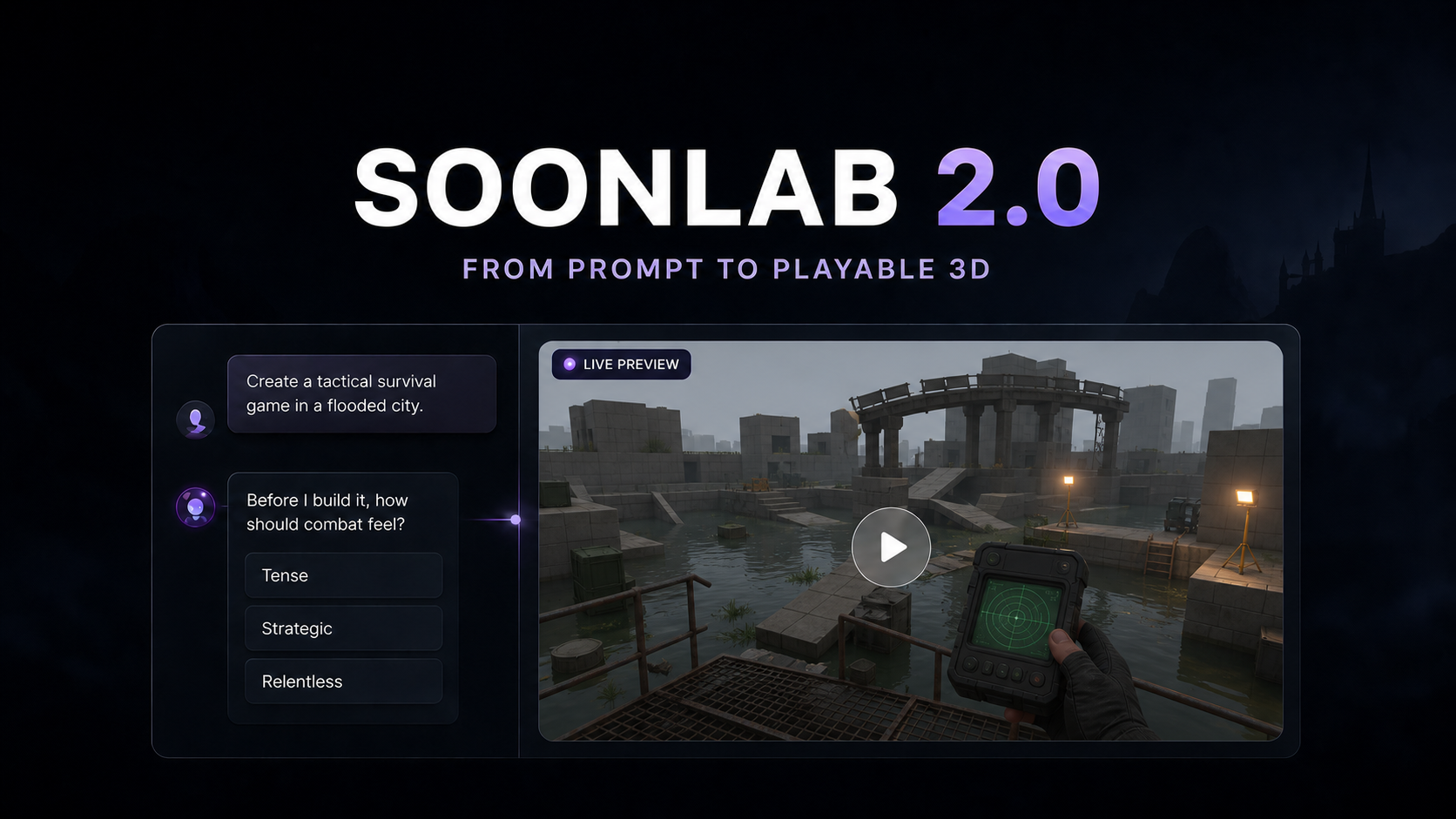
An illustrative view of SoonLab 2.0: creators clarify game requirements with an AI agent, generate a playable 3D prototype, and refine it through natural-language conversation. (Image: SoonLab)
The goal is simple: help anyone with a game idea get closer to the game they actually imagined — with less prompting, less trial and error, and no coding required.
With earlier generations of AI game creation, getting from an idea to something playable was already possible. But “playable” is only the beginning.
Creators still had to figure out how to describe mechanics precisely, translate creative intent into instructions AI could understand, and repeatedly correct results that technically worked but did not quite feel right.
SoonLab 2.0 is designed to close that gap.
From generating games to understanding how you want them to play
At the core of SoonLab 2.0 is a more fluid, agent-guided creation workflow.
Instead of treating a creator’s first prompt as a complete set of instructions, SoonLab 2.0 begins with a conversation. Before game creation formally begins, the agent asks follow-up questions and confirms the creator’s requirements — from gameplay mechanics and rules to interactions, difficulty, visual behavior, and the overall player experience.
By aligning on those choices first, the agent can create from a clearer brief — improving the quality of the first playable result and making the overall process feel more fluid.
This means creators can spend less time learning how to “talk to AI” and more time thinking about the game itself.
You bring the idea. SoonLab 2.0 helps clarify what you want before it starts to build.
A creation process that feels more like iteration, not regeneration
Game creation rarely ends with the first prompt.
A first version might reveal that the enemies are too easy. The movement might need to feel faster. A mechanic that sounded good in your head might need to become stranger, harder, or completely different once you actually play it.
SoonLab 2.0 is built around that reality.
Creators can start with a simple idea, play the result, then continue refining the game through natural conversation with the agent. Instead of rebuilding everything from scratch or translating every change into technical instructions, creators can simply describe what they want to change.
“Make the enemies twice as aggressive.”
“Add a risk-reward mechanic when the player’s health gets low.”
“Make the game progressively more chaotic every 30 seconds.”
With SoonLab 2.0, these are not coding tasks. They are natural requests the agent can use to modify the game.
The result is a tighter loop between idea conversation creation play iteration — allowing creators to discover what is fun by actually playing their ideas, rather than only imagining them.
From a single prompt to a playable 3D game
SoonLab 2.0 expands what creators can make beyond the 2D experiences supported before.
With a single sentence or prompt, creators can now generate a playable 3D game directly from natural language — without starting with a game engine or writing code.
Whether creators choose 2D or 3D, the starting point remains the same: describe the game you want to make in natural language, then play what SoonLab creates.
For creators, that expansion translates into something much simpler:
more kinds of game ideas can move from a prompt to a playable experience without changing how creators work.
Making game creation accessible before the first line of code
SoonLab is built for people who have ideas for games — whether or not they know how to build one traditionally.
A player can turn a strange idea into something friends can immediately play.
A creator can take a challenge suggested by their community and make it interactive.
An indie developer can prototype an unconventional mechanic before committing days or weeks to implementation.
And someone who has never opened a game engine can experience what it feels like to create a game for the first time.
SoonLab does not aim to replace the craft, judgment, and engineering required to ship a fully developed game. Instead, it gives more people access to the stage that comes before it:
the ability to turn an idea into something playable, test it, change it, and find out whether it is actually fun.
Toward an AI-native way of making games
AI has dramatically lowered the barrier to creating text, images, video, and software.
Games are different.
A game is not simply something you generate and look at. It is a system of rules, interactions, feedback, and possibilities that only fully reveals itself when someone plays it.
That is why SoonLab believes the next generation of AI game creation cannot stop at generation.
AI needs to understand creative intent, confirm requirements before creation begins, respond to what creators discover through play, and help them continuously shape the experience through conversation.
SoonLab 2.0 is a step toward that future — where making a game begins not with learning an engine or writing code, but simply with having an idea worth playing.
SoonLab 2.0 is available starting today at https://www.soonlab.ai/.
About SoonLab
SoonLab is an AI-native platform for creating and sharing playable games. Using natural language, creators can turn ideas into playable 2D and 3D experiences, confirm requirements with an AI agent before creation begins, modify gameplay through conversation, and share what they create — without starting with code.
SoonLab's mission is to make interactive creation accessible to anyone with an idea and enable a new generation of creators to move from imagination to something the world can actually play.
Press Inquiries
Molly
pr [at] soonlab.ai
https://www.soonlab.ai/
