Austin, TEXAS, Aug. 11, 2026 (GLOBE NEWSWIRE) -- The Fusion Equilibrium Challenge releases 133 GB of experimental tokamak data and challenges the global AI community to reconstruct plasma magnetic geometry using only non-magnetic diagnostics.
AI to Reconstruct Invisible Magnetic Structures Inside Fusion Reactors
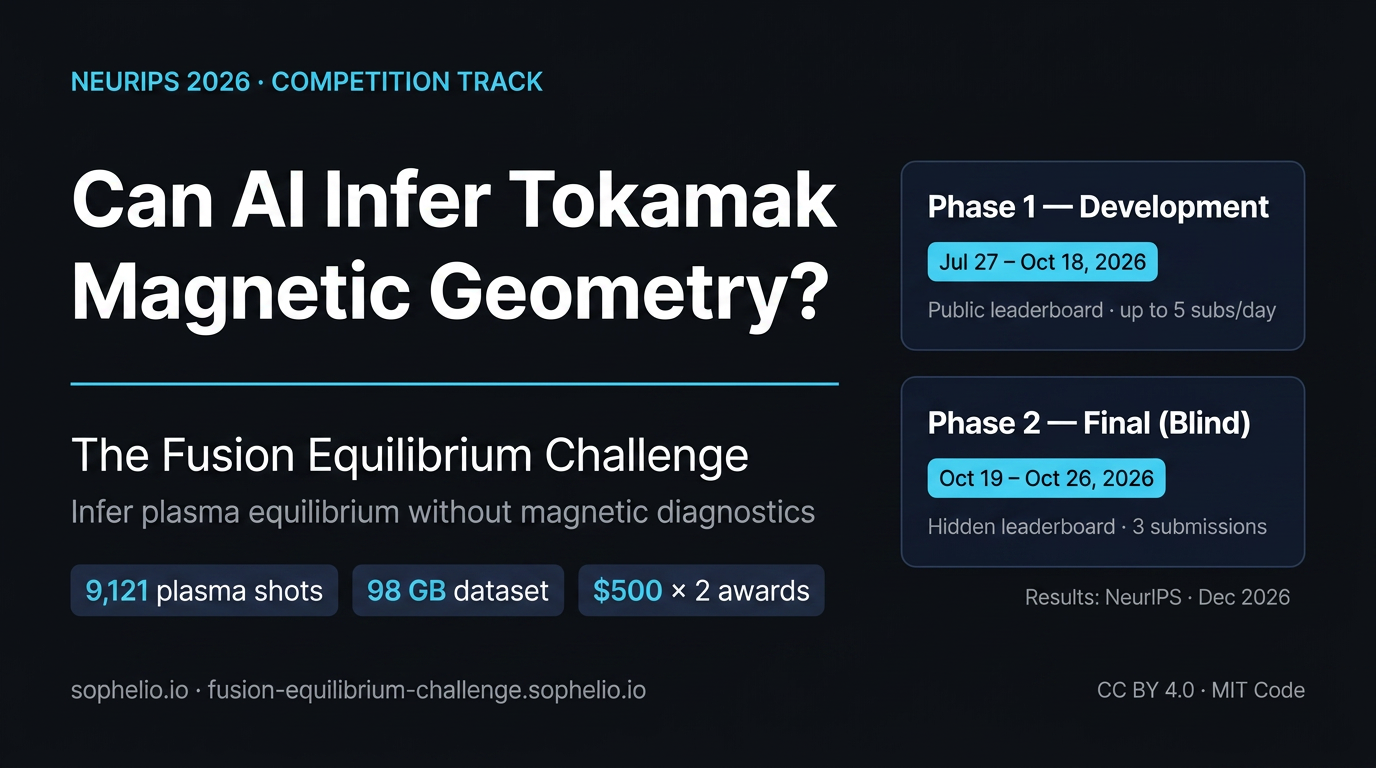
Sophelio today launched the Fusion Equilibrium Challenge, the first fusion energy competition accepted to the NeurIPS Competition Track. Organized in partnership with the DIII-D National Fusion Facility, UKAEA’s FAIR-MAST program, and the University of Texas at Austin (Institute for Fusion Studies (IFS)), with data hosted on Hugging Face, the challenge invites the global machine-learning community to reconstruct the invisible magnetic structure that confines a fusion plasma using only non-magnetic diagnostic measurements—a capability that future reactor-class fusion power plants may require for routine operation.
Future reactor-class devices such as ITER, SPARC, ARC, and CFETR will operate under neutron fluxes that degrade the magnetic sensors traditional equilibrium codes rely on. The Fusion Equilibrium Challenge asks whether machine learning can instead reconstruct the magnetic geometry that confines a fusion plasma—including the complete two-dimensional poloidal flux map, ψ(R,Z), and key equilibrium parameters—using only non-magnetic features such as poloidal-field coil currents and Thomson-scattering electron profiles. A successful solution could enable equilibrium inference when magnetic measurements are unavailable, degraded, or limited, supporting reduced-diagnostic operation and lowering diagnostic complexity for future reactor-class fusion systems.
The dataset, released under the CC BY 4.0 license on Hugging Face, contains 9,121 curated plasma discharges from two distinct experimental tokamaks: 7,915 from the DIII-D National Fusion Facility (San Diego) and 1,206 from MAST, released through UKAEA's FAIR-MAST program (Culham).
The challenge asks whether magnetic geometry can be inferred without magnetic diagnostics at all, using only non-magnetic measurements available during routine tokamak operation. The inclusion of multiple devices introduces a second and distinct scientific question: whether the resulting machine-learning models capture machine-specific correlations or discover representations that remain useful across devices with substantially different geometries, diagnostics, and operating conditions.
"Every major advance in machine learning has followed the release of open datasets and meaningful benchmarks. We believe fusion is ready for the same transition. By bringing the global AI community into a problem that future reactors will actually need solved, we're hoping to accelerate both fields at once."
Craig Michoski, Co-Founder and CEO, Sophelio
DIII-D is an operating experiment, not an archive. Beyond the released shots, the facility regularly runs experimental campaigns to address key needs in fusion science and technology. The program is planning campaigns to fill the gaps this challenge exposes — targeting the diagnostic conditions where reconstruction models are weakest.
Every discharge in the dataset can be explored using the Data Fusion Labeler (dFL), Sophelio's free desktop platform for multimodal sensor data. The visualizer enables participants to inspect magnetic flux contours, Thomson-scattering profiles, and diagnostic time series before developing or evaluating machine-learning models. Phase 1 of the competition is now open with a public Codabench leaderboard. Phase 2 begins in October 2026, with final results presented at NeurIPS 2026 in December. Two cash awards will recognize the highest-performing intra-machine reconstruction and the strongest zero-shot cross-machine generalization. Top-performing teams will also receive named co-authorship on the competition's lessons-learned paper and invitations to present their work at the NeurIPS Competition Workshop.
Registration is now open. Researchers, students, and practitioners from both machine learning and fusion energy are invited to participate beginning today. The challenge website, dataset, leaderboard, and visualization tools are available at fusion-equilibrium-challenge.sophelio.io.
Highlights
The Fusion Equilibrium Challenge, accepted to the 2026 NeurIPS Competition Track, will release ~9,100 curated experimental datasets from MAST and DIII-D as an open benchmark for reactor-relevant equilibrium inference. The competition invites the global AI community to address the challenge of reconstructing magnetic equilibria without the use of magnetic sensor data.
This matters for fusion reactors because magnetic sensors are difficult to sustain in a reactor environment, and field integrator drift becomes an issue for long pulse operation. This open benchmark is intended to accelerate the development of machine-learning methods for fusion energy and increase the accessibility and impact of publicly funded experimental datasets.
The work is led by Craig Michoski at Sophelio (sophelio.io) under DOE grants DE-SC0025987 and DE-SC0024426. Some of this material is based upon work supported by the U.S. Department of Energy, Office of Science, Office of Fusion Energy Sciences, using the DIII-D National Fusion Facility, a DOE Office of Science user facility, under Award DE-FC02-04ER54698.
About Sophelio
Sophelio is an Austin, Texas-based ML/AI company building the #1 Labeling Platform for Sensor AI. Its flagship product, the Data Fusion Labeler (dFL), is a signal-first time-series labeling and harmonization platform for multimodal sensor data — used in fusion energy, robotics, additive manufacturing, biomedical, and climate machine learning. Sophelio is a DOE award recipient. sophelio.io
About the DII-D National Fusion Facility
DIII-D is the largest magnetic fusion research facility in the U.S. and has been the site of numerous pioneering contributions to the development of fusion energy science. As a fusion testbed enabling critical science and technology advances, DIII-D continues the drive toward practical fusion energy with innovative research conducted in collaboration by more than 800 scientists representing over 100 institutions worldwide. Research at DIII-D, a U.S. Department of Energy, Office of Science User Facility, is open to all interested parties. For more information, visit www.d3dfusion.org.
Media contact — Sophelio
Jerry Louis-Jeune, media@sophelio.io
Media contact — DIII-D National Fusion Facility
Lindsay Ward-Kavanagh, wardkavanagh@fusion.gat.com
_________________________________________________________________
fusion-equilibrium-challenge.sophelio.io · huggingface.co/datasets/Sophelio/fusion-equilibrium-challenge · github.com/Sophelio/dFL, d3dfusion.org
Press Inquiries
Jerry Louis-Jeune
jerry [at] sophelio.io
https://sophelio.io
2008 Holland Ave #B,
Austin TX 78704