Tampa, FL, July 28, 2026 (GLOBE NEWSWIRE) -- Two-thirds of KashKick users surveyed distrust companies with their personal data — yet nearly half say they would turn tracking on in exchange for rewards or discounts, according to new proprietary survey data from KashKick, a rewards platform that pays users via PayPal, Venmo and gift cards.
The finding lands at a moment when consent, not the cookie itself, has become the deciding factor in whether companies can collect data. Google ultimately declined to deprecate third-party cookies in Chrome and wound down most of its Privacy Sandbox alternatives in late 2025 — but Safari, Firefox and Brave still block them by default, roughly a fifth of web traffic is already cookieless, and regulators increasingly treat explicit permission as non-negotiable. The result is an industry leaning on first-party data and direct opt-in, where the practical question is no longer whether tracking is technically possible but whether a person will say yes.
In KashKick's Digital Tracking Survey, fielded in June 2026, 48% of users surveyed said they would enable tracking in exchange for rewards or discounts — more than double the next-highest reason users gave for opting in, receiving personalized content (24%). Relevant ads (20%) and personalized product recommendations (24%) trailed. Rewards were the single strongest lever tested, by a wide margin — the concrete "something in return" that the value-exchange model depends on.
Part of why a reward moves the needle is that most users aren't fixed in their views. The largest single group — 34% — said their comfort with tracking depends heavily on the specific situation, rather than accepting or rejecting it outright. For a conditional audience like that, the terms of the exchange are what decide the answer, and a specific reward is the clearest term a company can offer.
That willingness doesn't mean users have made peace with tracking — the same audience is deeply wary of it. Asked separately about trust, a combined 66% said they are skeptical of how companies handle their data or don't trust companies at all, and 68% said companies should obtain explicit consent before collecting their data, always or in most cases. In other words, two things are true of this audience at once: broad distrust of how data is handled, and a concrete willingness to opt in when there's a clear reward attached. The 48% and the 66% come from different questions, not a single split — but together they define the gap a marketer has to close.
That wariness tracks with national research. A 2023 Pew Research Center survey found that 67% of Americans say they understand little to nothing about what companies do with their personal data, and 81% expect that information to be used in ways they aren't comfortable with — closely mirroring the 62% of KashKick users surveyed who say they understand little or only some of how their own data is used.
"This is the tension every marketer is now working inside," said Yasmin Marinaro, VP of Consumer Marketing at KashKick. "People don't trust companies with their data, and they still want to be asked first. But offer something concrete in return and half of them will say yes. Rewards close a gap that promises of 'a more personalized experience' simply don't."
A guarded audience, not a passive one
The distrust isn't abstract. Location tracking is users' single biggest concern, cited by 63% — nearly double the next-closest category, social media behavior tracking (36%). And users act on that concern: 74% said they have used at least one privacy tool, such as private browsing, a VPN or an ad blocker, and 48% have adjusted their device or browser settings specifically to limit tracking.
The takeaway is not an audience that will trade away privacy cheaply. It is an audience that guards its data deliberately — and opts in anyway when the exchange is worth it.
Why this matters for marketers
With consent now the gating factor rather than the cookie, the data suggests transparency alone won't move the needle without a tangible offer attached. A consent request built around a specific, quantifiable reward is likely to outperform one built around personalization or convenience. KashKick's own model lets users earn cash online or collect gift cards for engaging with surveys, apps and offers — has run on that exact exchange for years, ahead of the industry's current pivot toward first-party data and direct opt-in
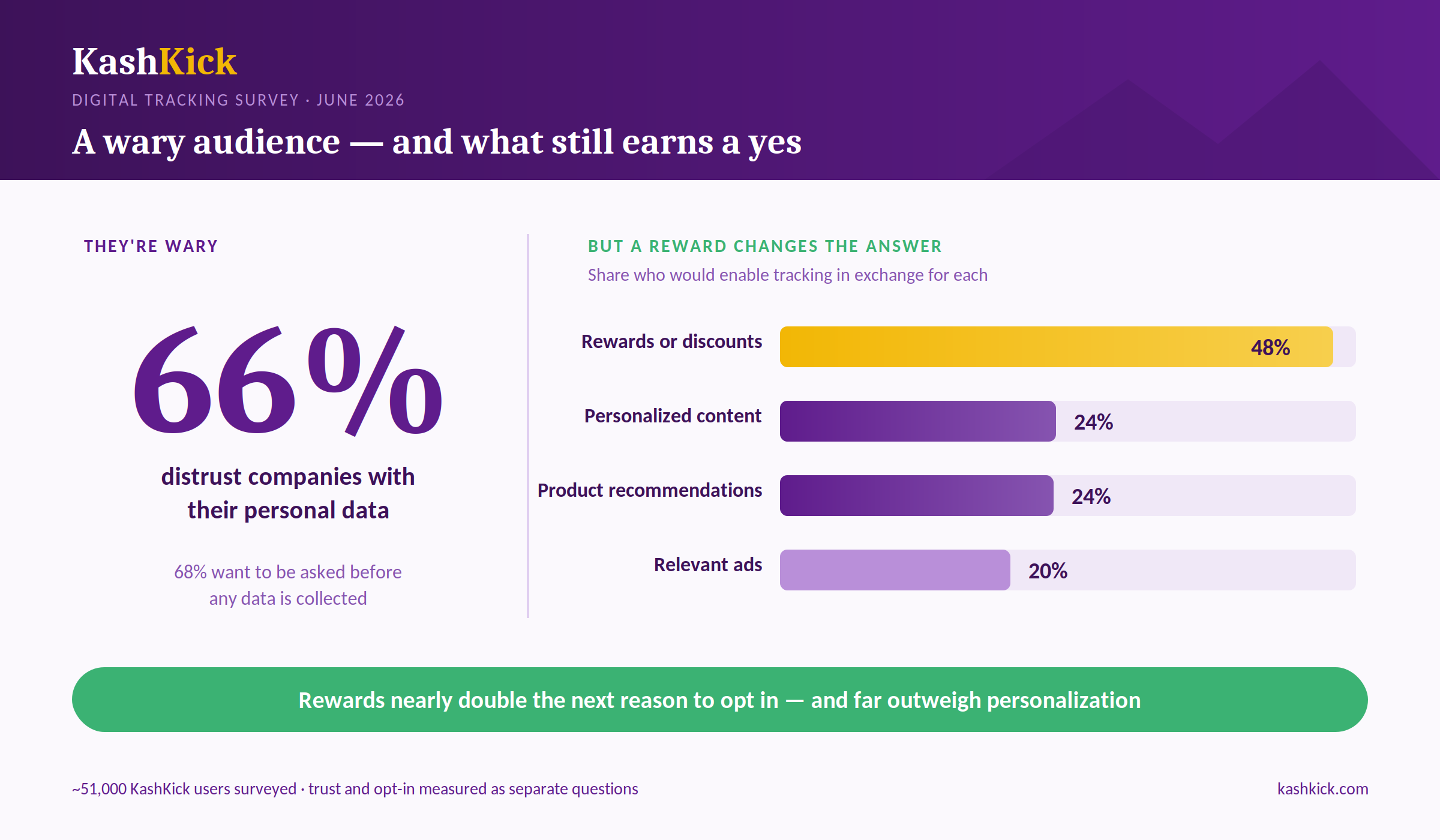
Distrust runs high, but a concrete reward — not personalization — is what earns the opt-in. Source: KashKick Digital Tracking Survey, June 2026
About KashKick
Founded in 2017, Kashkick is a U.S.-based rewards platform that pays members in cash and gift card rewards for playing games, completing surveys, trying new apps, and engaging with offers. Members can cash out via PayPal or Venmo, or redeem earnings for gift cards from leading retailers. Built for the next generation of earners, KashKick bridges the gap between brand discovery and consumer empowerment, giving users control over how they engage and earn. https://kashkick.com/
Press Inquiries
Yasmin Marinaro
yasmin [at] kashkick.com
https://kashkick.com
615 Channelside Drive, Ste 207 Tampa FL 33602

