- IBI363 in combination with chemotherapy demonstrated encouraging efficacy signals and manageable safety in the first-line treatment of NSCLC with PD-L1 negative or low expression. The 3→1.5 mg/kg dose group (n=22) showed ORR of 86.4%, confirmed ORR (cORR) of 81.8% (95% CI: 59.7-94.8) and DCR of 100%
- The second stage of the PoC study is ongoing in head-to-head comparison vs. pembrolizumab plus chemotherapy in the first-line treatment of advanced NSCLC (all PD-L1 expression levels)
- Innovent and Takeda are co-developing IBI363 (Takeda R&D code: TAK-928) globally.
SAN FRANCISCO and SUZHOU, China, May 31, 2026 /PRNewswire/ -- Innovent Biologics, Inc. ("Innovent") (HKEX: 01801), a world-class biopharmaceutical company that develops, manufactures and commercializes high quality medicines for the treatment of oncology, cardiovascular and metabolic, autoimmune, ophthalmology and other major diseases, today announced the preliminary results from a PoC clinical study of its global first-in-class PD-1/IL-2α-bias bispecific fusion protein IBI363 (Takeda R&D code: TAK-928) plus chemotherapy in the first-line treatment of advanced non-small cell lung cancer (NSCLC). The detailed data was presented today at the 2026 American Society of Clinical Oncology (ASCO) Annual Meeting.
This study is the first stage of a PoC clinical study conducted in China, to evaluate the safety, efficacy, and dose optimization strategy of IBI363 in combination with platinum-based doublet chemotherapy (PDC) in previously untreated patients with locally advanced or metastatic NSCLC.
As of the data cutoff date, Dec 22, 2025, a total of 80 patients had been enrolled in this Phase 1 study, including 11 patients enrolled in the safety lead-in phase and 69 patients in the dose optimization phase. The median follow-up time was 5.8 months (range: 0.9–9.5 months). During dose optimization, patients with NSCLC expressing PD-L1 TPS < 50% (including TPS 1-49% and TPS < 1%) were enrolled and randomized 1:1:1 into three dose cohorts. A detailed mechanistic explanation of the IBI363 dose optimization strategy is provided at the end of this article.
- 3→1.5 mg/kg IBI363 dose group:3 mg/kg + PDC in cycle 1, followed by 1.5 mg/kg once every 3 weeks (Q3W) + PDC
- 1.5 mg/kg IBI363 dose group: 1.5 mg/kg Q3W + PDC
- 3 mg/kg IBI363 dose group: 3 mg/kg Q3W + PDC
Among the 80 patients, the median age was 64 years, 88.8% were male, 81.3% had an ECOG PS score of 1, and 66.3% had squamous NSCLC. The baseline characteristics of patients in the three dose groups were balanced and comparable. In the dose optimization part, 65.2% patients had NSCLC tumors demonstrating PD-L1 TPS < 1% and 34.8% had TPS 1–49%.
In the IBI363 3→1.5 mg/kg Dose Group, ORR Exceeded 80% in the First-line Treatment of NSCLC, Across Histologies and Particularly in PD-L1 Negative or Low Expression
Preliminary efficacy data in this study showed an encouraging response rate of IBI363 in combination with PDC in the first-line treatment of NSCLC with PD-L1 negative or low expression. Notably, the 3→1.5 mg/kg dose group (n=22) showed an ORR of 86.4% (95% CI: 65.1–97.1), with a confirmed response rate (cORR) of 81.8% and DCR of 100%.
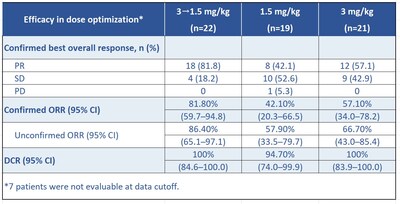
Furthermore, the encouraging efficacy was observed across histologies, particularly in tumors expressing PD-L1 TPS <50%.
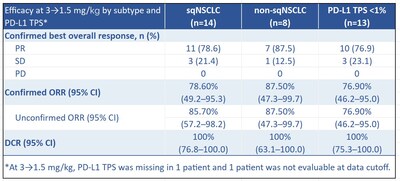
The encouraging efficacy data further validates IBI363's unique mechanism of actions as a PD-1/IL-2α-bias bispecific fusion protein, which is capable of exerting potent anti-tumor effects regardless of PD-L1 expression status, underscoring the powerful immune-activating effects of specifically targeting the alpha-receptor of IL-2.
Favorable Safety Supports Continuous Administration with Potential to Translate into Long-term Efficacy Benefits
Grade ≥3 treatment-related adverse events (TEAEs) occurred in 65.2% of patients in the 3→1.5 mg/kg dose group; this rate was lower than in the 1.5 mg/kg dose group (82.1%) and the 3 mg/kg dose group (93.1%). The favorable safety and tolerability profile of 3→1.5 mg/kg IBI363 in combination therapy enables potential translation into durable efficacy benefits for first-line NSCLC treatment.
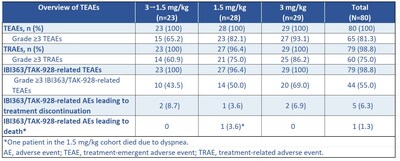
Grade ≥3 TEAEs experienced by ≥15% of all patients were neutrophil count decrease (42.5%), white blood cell count decrease (20.0%), anemia (18.8%), and platelet count decrease (17.5%).
Conclusion and Next-step:
Based on the comprehensive evaluation of preliminary efficacy and safety data, the dose regimen of 3→1.5 mg/kg is the recommended dose for further clinical investigation of IBI363 combined with chemotherapy as a first-line treatment for advanced NSCLC. Currently, the second part of the PoC study, a randomized head-to-head study of IBI363 3→1.5 mg/kg combined with chemotherapy vs. pembrolizumab combined with chemotherapy as first-line treatment for advanced NSCLC (all PD-L1 expression levels) is ongoing.
Professor Yilong Wu of Guangdong Provincial People's Hospital stated: "At present, first-line standard treatment for advanced non-small cell lung cancer without driver gene alterations is mainly PD-1/PD-L1 antibodies plus chemotherapy. With the advent of a new generation of immunotherapies, first-line NSCLC research has entered a new era. As the world's first PD-1/IL-2α-bias bispecific fusion protein, IBI363 has shown encouraging preliminary data in combination with chemotherapy. In the PD-L1–negative and low-expression population, the 3→1.5 mg/kg cohort achieved impressive objective response rates, suggesting potent immune activation and anti-tumor effects regardless of PD-L1 status. Adverse events were mainly chemotherapy-related hematologic toxicities, and overall safety was manageable, supporting the potential for prolonged first-line treatment cycles that may translate into durable efficacy benefits. We look forward to seeing more positive and sustained results from this study."
Dr. Zhou Hui, Chief R&D Officer (Oncology Pipeline) of Innovent, stated: "IBI363 is designed to overcome the key bottleneck of current immunotherapy. Study findings presented at 2026 ASCO demonstrate that through mechanism-guided dose optimization—specifically the 3→1.5 mg/kg dose regimen tailored to its PD-1/IL-2α-biased immune-activating profile— IBI363 achieved an encouraging response rate in the first-line treatment of patients with PD-L1 negative or low expressing NSCLC. At the same time, its favorable safety and tolerability holds the potential to translate into long term efficacy benefits. This not only further validates the mechanism but also represents a significant step for the clinical advancement of IBI363. We look forward to further validation of IBI363 in first-line NSCLC setting and the accumulation of data from the ongoing head-to-head PoC study."
Mechanistic Rationale for IBI363 Dosing Strategy
The dose optimization of IBI363 is precisely tailored to patient immune status and TME features across different treatment lines.
For patients with IO-resistant NSCLC, these patients exhibit an immunosuppressive tumor microenvironment (TME) characterized by Treg enrichment, M2‑like tumor‑associated macrophage polarization, and effector T‑cell exhaustion. Re‑activation and sustained stimulation of anti‑tumor immunity are required. Continuous high‑intensity IL‑2 signaling reinvigorates exhausted T cells and reverses TME‑mediated immune suppression.
- IBI363 3mg/kg Q3W monotherapy demonstrated long-term survival benefits in the PoC study with updated data presented at this year's ASCO. A global multicenter Phase III MRCT trial (Marslight‑11) comparing IBI363 3mg/kg Q3W monotherapy head‑to‑head with docetaxel is currently ongoing.
Moving into IO-naive populations, multiple studies have indicated that the tumor microenvironment exhibits lower immunosuppression, which allows an immune activation strategy that ignites immunity and then maintains stability. Meanwhile, combination with chemotherapy can facilitate antigen release and activate the immune system.
Therefore, the first cycle of 3 mg/kg IBI363 could initiate the immune system to expand effector T cells rapidly, enhance T cell infiltration, and establishment of an immunotherapy-sensitive TME. Subsequently, a 1.5 mg/kg Q3W regimen is adopted for maintenance treatment, which could preserve IO-sensitivity in the tumor microenvironment, prolong treatment duration, and further enhance the therapeutic efficacy. This dosing strategy is consistent with the study design of other immunological treatments.
- At this year's ASCO, clinical data from the dose optimization phase of the PoC study showed that the IBI363 3→1.5 mg/kg regimen plus chemotherapy as first-line treatment for PD-L1 negative or low-expressing NSCLC demonstrated encouraging efficacy signal and a favorable safety profile. The second stage of this PoC study—a randomized controlled trial of IBI363 3→1.5 mg/kg plus chemotherapy versus pembrolizumab plus chemotherapy as first-line treatment for advanced NSCLC (all PD-L1 expression levels)—is currently ongoing.
About IBI363 (PD-1/IL-2α-bias Bispecific Fusion Protein)
IBI363 is a first-in-class PD-1/IL-2α-bias bispecific fusion protein developed by Innovent Biologics. It functions by both blocking the PD-1/PD-L1 pathway and selectively activating the IL-2 pathway. The IL-2 arm of IBI363 is designed to maintain its affinity for IL-2Rα while reducing binding to IL-2Rβ and IL-2Rγ, thereby minimizing toxicity. The PD-1 binding arm not only blocks PD-1 but also selectively delivers IL-2 to the tumor through binding to IL-2 receptor alpha.
IBI363 is being evaluated in a series of clinical trials globally, led by a pivotal Phase II study in China in previously untreated acral and mucosal melanoma and a global multi-regional Phase III trial in immunotherapy-resistant squamous NSCLC. In parallel, multiple Phase Ib/II trials are evaluating IBI363 in NSCLC and CRC including the first-line and later line settings, and in additional tumor types. IBI363 has received two Fast Track Designations (FTD) from the U.S. FDA and three Breakthrough Therapy Designations (BTD) from China NMPA so far.
In October 2025, Innovent entered into a license and collaboration agreement with Takeda, under which Innovent and Takeda will co-develop IBI363 (Takeda R&D code: TAK-928) globally and co-commercialize IBI363 in the U.S., and Takeda will exclusively commercialize IBI363 worldwide other than the U.S. and greater China.
About Innovent
Innovent is a leading biopharmaceutical company founded in 2011 with the mission to empower patients worldwide with affordable, high-quality biopharmaceuticals. The company discovers, develops, manufactures and commercializes innovative medicines that target some of the most intractable diseases. Its pioneering therapies treat cancer, cardiovascular and metabolic, autoimmune and eye diseases. Innovent has launched 18 products in the market. It has 5 assets in Phase III or pivotal clinical trials and 14 more molecules in early clinical stage. Innovent partners with over 30 global healthcare companies, including Eli Lilly, Roche, Takeda, Sanofi, Incyte, LG Chem and MD Anderson Cancer Center.
Guided by the motto, "Start with Integrity, Succeed through Action," Innovent maintains the highest standard of industry practices and works collaboratively to advance the biopharmaceutical industry so that first-rate pharmaceutical drugs can become widely accessible. For more information, visit www.innoventbio.com, or follow Innovent on Facebook and LinkedIn.
Forward-looking statement
This news release may contain certain forward-looking statements that are, by their nature, subject to significant risks and uncertainties. The words "anticipate", "believe", "estimate", "expect", "intend" and similar expressions, as they relate to Innovent Biologics ("Innovent"), are intended to identify certain of such forward-looking statements. The Company does not intend to update these forward-looking statements regularly.
These forward-looking statements are based on the existing beliefs, assumptions, expectations, estimates, projections and understandings of the management of the Company with respect to future events at the time these statements are made. These statements are not a guarantee of future developments and are subject to risks, uncertainties and other factors, some of which are beyond the Company's control and are difficult to predict. Consequently, actual results may differ materially from information contained in the forward-looking statements as a result of future changes or developments in our business, the Company's competitive environment and political, economic, legal and social conditions.
The Company, the Directors and the employees of the Company assume (a) no obligation to correct or update the forward-looking statements contained in this site; and (b) no liability in the event that any of the forward-looking statements does not materialise or turn out to be incorrect.
 View original content to download multimedia:https://www.prnewswire.com/news-releases/2026-asco--innovent-presents-preliminary-poc-data-of-ibi363-tak-928-pd-1il-2-bias-bispecific-fusion-protein-in-first-line-advanced-nsclc-302786452.html
SOURCE Innovent Biologics
