Supported by DTE Energy, the microgrid system reduces peak demand, offsets power quality fluctuations and validates strategies to feed green electricity back to the grid.
DETROIT, May 18, 2026 /PRNewswire/ -- Delta Electronics, a global leader in power management and smart green solutions, today announced a microgrid system at its own Detroit-area facility, developed in partnership with DTE Energy and through the seamless integration of its smart energy solutions. Unlike conventional power systems, this microgrid connects directly through a medium-voltage DTE Energy interconnection, enabling Delta to test grid-interactive energy strategies under live utility conditions and, in the future, to actively support the grid. The microgrid also serves as a validation environment for customers evaluating grid-interactive and microgrid-based power strategies.
Austin Tseng, President of Delta Electronics Americas, said, "Grid resiliency is quickly becoming one of the defining challenges for communities, businesses, and utilities alike. With our Detroit microgrid, we are operating real energy infrastructure under real grid conditions to understand how systems respond, are controlled, and can contribute to grid stability. Rather than individual technologies in isolation, this system responds dynamically to grid conditions, facility needs, and utility signals. This approach is increasingly relevant for data centers and commercial operators navigating constrained grid environments and rising electricity costs."
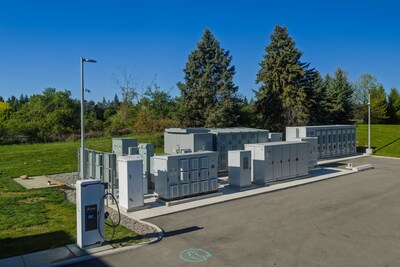
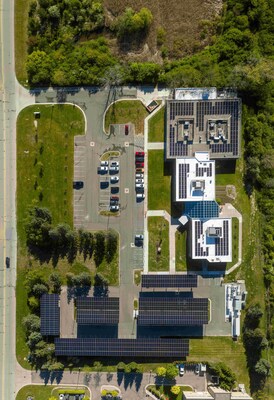
Delta's Detroit facility onsite microgrid integrates 425 kW of solar generation, eight Level 2 EV chargers, and a 400 kW DC fast EV charger developed through a Department of Energy (DOE)-funded program. This microgrid connects these assets through a 13.2 kV medium-voltage interconnection provided by DTE Energy—a point on the grid typically reserved for utility-scale infrastructure that was completed in April. The microgrid is supported by Delta's 3MW Power Conditioning System (PCS) and 2.8 MWh of stationary Battery Energy Storage System (BESS). At the software level, the microgrid's operations are controlled by Delta's Energy Management System (EMS) and monitored by the in-house VTScada SCADA platform.
At the core of the system is a solid-state transformer (SST) supported by a DOE grant. Unlike conventional passive transformers, the SST uses digitally controlled power conversion to enable faster grid response, real-time voltage regulation, and more precise coordination across the microgrid, helping improve system efficiency and enabling more precise control of power flows under dynamic load conditions.
Together, these assets have already reduced the facility's reliance on grid power by approximately 50 percent annually. During the summer, solar generation is sufficient to power the entire building, achieving net-zero operation. For the other six months of the year, energy storage provides load shaving to lower peak demand charges and reduce the facility's electricity costs.
Once fully operational, the installation will run under live grid conditions daily, helping reduce strain on public infrastructure during peak demand periods and generating real-world performance data on how commercial energy systems can be built and scaled, providing insights that can help commercial and data center operators reduce peak demand costs and improve power reliability. The site is open for customer engagement, enabling evaluation of microgrid performance and grid-interactive strategies under real operating conditions.
"Laboratory testing shows how a technology performs on its own," said William Mao, Vice President of Energy Solutions for Delta Electronics Americas. "What it does not reveal is how systems interact when they are tied into a live grid. Day-to-day usage provides the data and experience that directly shape how resilient, grid-interactive energy systems can be designed and deployed at scale."
Additional assets to realize grid resilience
The microgrid is expected to build on this foundation with five energy storage circuits, including two back-to-back 5 MWh units to be installed by year's end and configured to emulate large electrical loads, allowing Delta to test black-start scenarios, off-grid switching, and grid-loss recovery without requiring a physical MW-scale load on site. Additionally, a 300 kW gas turbine is planned to add the ability to study how solar, storage, and gas generation interact as grid conditions change.
Using its own facilities as a "Living Laboratory," Delta's microgrid control and energy management platform runs across varying combinations of generation, storage, EV charging, and grid connection states, offering customers real operational data on grid-resilient strategies before they deploy at scale.
About Delta Electronics (Americas)
Headquartered in Fremont, CA, Delta Electronics (Americas) is a subsidiary of Delta Electronics, Inc. (TWSE: 2308), a global leader in power management and smart green solutions. We have operated in the Americas for almost 40 years, with offices, R&D centers, manufacturing, and service facilities across the U.S., Canada, Mexico, Brazil, and more. Our smart, energy-saving solutions serve customers across data centers, IT, telecom, renewable energy and microgrids, EV charging and powertrains, building automation, industrial automation, lighting, and other major industries. Please visit: www.deltaww.com | www.delta-americas.com

 View original content to download multimedia:https://www.prnewswire.com/news-releases/delta-electronics-americas-smart-energy-solutions-enable-microgrid-in-detroit-for-commercial-facilities-to-lower-electricity-costs-302774382.html
SOURCE Delta Electronics (Americas)
