TSX:ORV
OTCQX: ORVMF
TORONTO, April 27, 2026 /PRNewswire/ - Orvana Minerals Corp. (TSX: ORV) (OTCQX: ORVMF) ("Orvana" or the "Company") is pleased to report exploration updates in Spain for the second quarter of fiscal year 2026, ended March 31, 2026 ("Q2 FY2026"). The Company's ongoing exploration programs at Orovalle are focused on extending known mineralization and supporting potential mine life growth.
- Highlights
El Valle–Boinás:- 2,845 metres drilled in Q2 FY2026, mainly focused on Area 208 and Black Skarn.
- Infill drilling supports the continuity of oxide-hosted gold mineralization in Area 208, which remains open to the east based on current drilling.
- Brownfield drilling intersected gold mineralization in Area 208. Significant intercepts include (apparent width):
- DDH 26A22020: 2.00 m @ 19.55 g/t Au and 0.30% Cu
- DDH 26A22021: 6.00 m @ 6.78 g/t Au
Results will inform future drilling programs focused on testing broader mineralization potential, subject to further evaluation and interpretation by the Company.
Lidia:
- 880 metres drilled in Q2 FY2026, completing the fiscal–year program, for a total of 1,427 metres drilled.
- Drilling results indicate that the target remains open to the southwest. Next steps will focus on evaluating this area to determine the extent of mineralization in that direction.
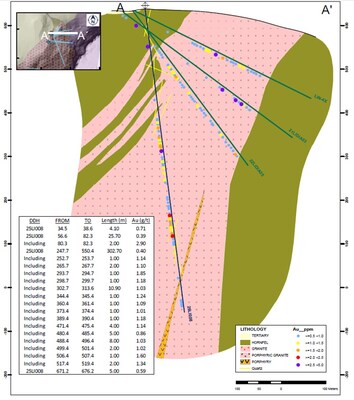
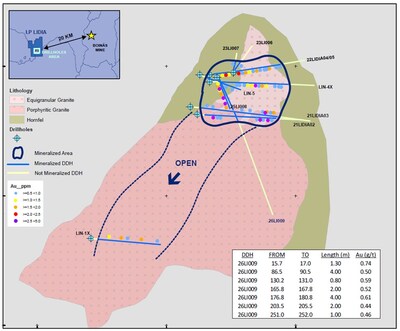
Reported intercepts for the El Valle–Boinás infill drilling (Figure 1) represent approximate true widths. Reported intercepts for the El Valle–Boinás brownfield drilling, presented in the Highlights section, and for the Lidia greenfield drilling (Figures 2 and 3), represent apparent widths.
- Summary
A total of 14 drill holes were completed during the quarter across the El Valle–Boinás and Lidia areas. Drill hole locations, orientations, and reported intercepts are illustrated in Figures 1 through 3 in this news release. These figures provide plan and sectional views of the drilling completed during Q2 FY2026 —together with historical drilling in these areas—, including the spatial relationship of drill holes to interpreted mineralized zones. The intercepts reported herein represent selected significant results from drilling completed in the areas shown. For infill drilling, reported intercepts approximate true widths, while for brownfield and greenfield drilling, reported intercepts represent apparent widths, as illustrated in Figures 1 through 3.
Orovalle - Q2 FY2026 | Infill | Brownfield | Greenfield | TOTAL |
El Valle Boinás | ||||
Area 208 | 826 | 969 | - | 1,795 |
Black Skarn | - | 1,050 | - | 1,050 |
Lidia | - | - | 880 | 880 |
TOTAL | 826 | 2,019 | 880 | 3,725 |
- El Valle–Boinás Brownfield Infill Program
At the El Valle Boinás mine, Q2 FY2026 drilling has focused on the Area 208 (A2), where 1,795 metres have been completed. Of this total, 826 metres were drilled with the objective of converting inferred resources (see Figure 1), while 969 metres were drilled to define the geological connection between the A2 and E2 structures (located to the east of A2). This work is expected to be completed in the coming months. The results are expected to inform the design and targeting of future drilling programs, subject to further evaluation and interpretation.
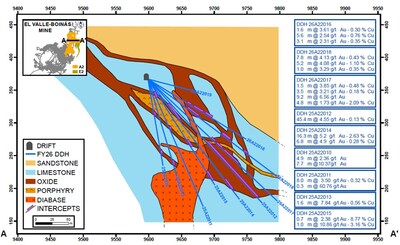
Mineralization in this zone of Area 208 is concentrated within bands, with variable thickness (between 5-10 m) of altered skarn and semi-jasperoid breccias within the limestone; subsequently, the intrusion of porphyry dikes led to silicification and mineral enrichment of these bands. The mineralized bands are dipping towards the southeast, with potential for further extension in that direction.
In addition, a total of 1,050 metres were drilled at the Black Skarn target to assess mineralization at deeper skarn levels. Further evaluation of the area is planned for future campaigns.
- Lidia Greenfield Program
At the Lidia Project, a total of 880 metres were completed during Q2 FY2026, completing the drilling campaign planned for fiscal 2026, which totalled 1,427 metres. Drill hole traces, assay intervals and geological interpretation are presented in Figures 2 and 3.
Lidia project is located in Navelgas Gold Belt, 20 km from El Valle mine. This gold porphyry occurs within the easternmost part of Navelgas fracture systems. A granodiorite intrusive outcrops over an area of approximately 1 km2. It is dissected by a set of northeast trending mineralized quartz veins and affected by different alteration phases. Orovalle carried out a drilling campaign between fiscal 2021 and fiscal 2022, confirming the presence of gold in the granodiorite (see NR April 17, 2023). During fiscal 2024, drilling work continued, allowing the northern part of the granodiorite to be defined (see NR January 16, 2024). For fiscal 2026, a 1,500 m drilling campaign was planned with the objective of defining mineralization at depth and towards the south, completing 1,427 metres in two drill holes (25LI008 and 26LI009).
The objective of DDH 25LI008 was to test the downward continuity of mineralization, for which it was planned with an inclination of -84 degrees. The hole was completed to a depth of 699.15 metres. The drill hole intersected fine-grained equigranular granodiorite with disseminated pyrite, transitioning at 247 metres into a porphyritic granodiorite affected by sericitic and potassic alteration. Quartz veins with various orientations were also encountered, likewise associated with sericitic and potassic alteration. Au mineralization was identified throughout the intrusive body, with a more intensely mineralize zone occurring at approximately 500 metres below surface. Assay results show 302.7 m (downhole length) at 0.40 g/t Au, including several higher-grade intervals such as 10.9 metres at 1.03 g/t Au (see Figure 2). These results support the interpretation that the mineralized body remains open at depth.
DDH 26LI009 was designed to test the southern extension of the mineralization and was drilled toward the southeast (azimuth 154º). While continuity of the intrusive body was intersected, mineralization terminates at approximately 289 metres downhole. As a result, the target area remains open to the southwest (based on current drilling), where a historical drill hole located 650 metres away has intersected mineralization. The next steps will focus on evaluating this area to determine the extent of mineralization in that direction (See Figure 3).
- Quality Control
Greenfield drill hole samples were sent to an external laboratory (ALS Laboratory) for analyses. Infill and brownfield drill holes samples were analyzed in Orovalle's Laboratory.
Sample preparation was carried out at the El Valle facility. All diamond core samples have been prepared using the following procedure, once split:
The core samples are dried at a temperature of 105ºC and then crushed through a jaw crusher to 70%<6 mm. The coarse-crushed sample is further reduced to 70%<425 microns using an LM5 bowl-and-puck pulverizer. An Essa rotary splitter is used to take a 450 g to 550 g sub-sample of each split for pulverizing. The remaining reject portion is bagged and stored. The sample is reduced by 85% to a nominal -200 mesh using an LM2 bowl-and-puck pulverizer. 150 g sub-samples are split using a special vertical-sided scoop to cut channels through the sample which has been spread into a pancake on a sampling mat. Samples are then sent to the laboratory for gold and base metal analysis. Leftover pulp is bagged and stored.
After sample preparation, 30g samples are analyzed for Au by fire assay with an atomic absorption spectroscopy (AAS) finish and one-gram samples for Ag, As, Bi, Cu, Hg, Pb, Sb, Se, and Zn by ICP optical emission spectroscopy (ICP-OES) after an aqua regia digestion. Sampling is carried out in batches of a maximum of 30 samples for the fire test and 42 samples for the acid digestion test, with the first and last samples being analyzed twice, also a standard and a blank is inserted in every batch by laboratory personnel. Gold values exceeding 16.7 g/t Au are automatically repeated by the metallic screening method, to confirm the grade of the sample. For A208 orebody core samples is used a 1000 g sub-sample of each split and 250 g sub-samples are split. 50 g samples are twice analyzed. In case of the twice analysis do not match, a metaling screening method is used to confirm the grade.
Greenfield drill holes samples are prepared by Orovalle and then sent to an external laboratory (ALS Laboratory) for analyses. 30 g samples are analyzed for Au by fire assay with an atomic absorption (Au AA-25) and 35 elements by ICP (ME-ICP41) after an aqua regia digestion. When Au and Ag values are >100 ppm and Cu and As values are >10,000 ppm, specific analysis methods are used to determinate the final grade.
In addition to the controls inserted by laboratory personnel, geologists insert certified reference material (CRM), blanks and duplicate samples into the sample stream. The on-site senior geologist reviews the results prior to acceptance of the assay results. Orovalle repeats the entire batch analysis if the standard falls outside acceptable limits. If a blank or duplicate is observed to fail, 20% of the batch is re-assayed. If the 20% that is re-assayed does not match the original analysis, then the entire batch is re-analyzed.
The technical information in this news release, including geological, assay, and drilling interpretation data, has been reviewed and approved by Guadalupe Collar Menéndez, a Qualified Person under National Instrument 43-101, who is not independent of the Company, and an employee of Orovalle Minerals S.L., a subsidiary of Orvana.
Consolidated Operational and Financial Performance
Q2 FY2026 consolidated operational and financial highlights will be released with the second quarter financials, expected mid-May, 2026.
ABOUT ORVANA – Orvana is a multi-mine gold-copper-silver company. Orvana's assets consist of the producing Orovalle operation in northern Spain; the Don Mario operation in Bolivia; and the Taguas property located in Argentina. Additional information is available at Orvana's website (www.orvana.com).
Cautionary Statements – Forward-Looking Information
Certain statements in this news release constitute forward-looking statements or forward-looking information within the meaning of applicable securities laws ("forward-looking statements"). Forward-looking information in this news release includes, without limitation, statements regarding, among other things, current expectations, estimates, projections and assumptions about future events and operating performance, including: interpretations regarding the continuity and extent of mineralization and whether such mineralization remains open, the potential extent of mineralized zones, and the timing, scope and direction of future exploration programs and next steps, including the interpretation of drilling results and the potential implications for future exploration and development activities.
Forward-looking statements are not statements of historical fact and are generally identified by words such as "believes", "expects", "plans", "estimates", "intends", "anticipates", "forecasts", "projects", "may", "could", "would", "might" or "will", or similar expressions.
Forward-looking statements are necessarily based upon a number of estimates and assumptions that, while considered reasonable by the Company as of the date of such statements, are inherently subject to significant business, economic and competitive uncertainties and contingencies. The estimates and assumptions, including those relating to production guidance and ramp-up expectations, underlying the forward-looking statements in this news release include, without limitation: (i) timely completion of planned maintenance, commissioning and ramp-up activities; (ii) no material disruptions to operations due to labour, supply chain, power, equipment damage or other events; (iii) permitting, development, operations and expansion activities at Orovalle, Don Mario and Taguas proceeding consistent with the Company's current expectations; (iv) political, regulatory and social conditions in the jurisdictions in which the Company operates remaining broadly consistent with the Company's current expectations; (v) commodity prices and input costs (including labour, energy and key supplies) remaining within ranges consistent with the Company's current expectations; (vi) the accuracy of the Company's current mineral reserve and mineral resource estimates; and (vii) the availability of necessary funds to execute the Company's plans. There can be no assurance that such expectations or guidance will be achieved. Exploration results are inherently uncertain and subject to further interpretation, which may affect the Company's understanding of mineralization and future exploration plans.
A variety of risks, uncertainties and factors, many of which are beyond the Company's control, could cause actual results to differ materially from those expressed or implied by forward-looking statements. These risks, uncertainties and factors include, among others: delays or difficulties in obtaining or maintaining necessary permits and authorizations (including environmental and tailings-related authorizations); the impact of global economic and geopolitical conditions; fluctuations in the price of gold, silver and copper; variations in ore grades, metallurgical recoveries and throughput; failure to achieve production estimates or guidance; increases in operating costs (including energy, power and environmental compliance costs); availability of qualified personnel; risks generally associated with mineral exploration and development; the Company's ability to successfully resume production at Don Mario; the Company's ability to successfully carry out exploration and development plans at Taguas; the Company's ability to obtain financing on acceptable terms when required; challenges to the Company's property interests and mineral rights; and legislative, regulatory, political, social and economic developments in the countries in which the Company operates. Additional risks are described in the Company's most recent Management's Discussion and Analysis and Annual Information Form, available under the Company's profile at www.sedarplus.ca.
Forward-looking statements are based on management's current plans, estimates, projections, beliefs and opinions, and except as required by law, the Company does not undertake any obligation to update forward-looking statements. Readers are cautioned not to place undue reliance on forward-looking statements and actual results may differ materially from those expressed or implied in such statements.

 View original content to download multimedia:https://www.prnewswire.com/news-releases/orvana-reports-q2-fy2026-exploration-results-in-spain-302754740.html
SOURCE Orvana Minerals Corp.
