- Submitted GraftAssureDx™ for kidney transplant rejection testing for FDA review on Wednesday, March 25
- Welcomed second favorable head-to-head data set from an independent study at large hospital comparing GraftAssure to a leading centralized transplant rejection test
- Expect U.K. CE marking via self-certification in Q2 2026
- Completed $26 million financing in February; funds intended to support expansion into heart transplantation market while also commercializing testing for kidney
NASHVILLE, Tenn., March 26, 2026 (GLOBE NEWSWIRE) -- Insight Molecular Diagnostics Inc., iMDx, (Nasdaq: IMDX), today published the following letter to shareholders in conjunction with its fourth quarter results:
Fellow shareholders,
We are pleased to share that GraftAssureDx has become, to our knowledge, the first ever kitted dd-cfDNA assay to be submitted to the FDA for regulatory review. Our FDA submission this week represents the culmination of 12 years of clinical development and three years of highly focused technical product development.
We see many positive signals that the transplant community is ready for GraftAssureDx.
In the past three months, we have doubled the number of transplant centers interested in what we are building. We are now engaged with 37 centers in the U.S. and 11 internationally, through our research-use-only assay as well as through our registry study. The 37 centers that we are engaged with in the U.S. include 28 transplant centers that want to join our registry trial, which we discuss in more detail under “2026 goals.”
We are thrilled to be able to share such a significant improvement in market access since our last update. The 37 centers in the U.S. with which we are engaged represent more than 25% of all transplants performed annually in the United States. We look forward to engaging with more centers over the coming quarters as word continues to spread about the advantages of our technology.
We expect that our test kits will deliver new value in the roughly $2 billion addressable market for regulated transplant rejection testing. We believe we are delivering the right product to the right market, at the right time, and that we are in the first stages of a dramatic shift in patient management, positioning ourselves to lead.
It's clear to us that market demand for regulated and decentralized molecular testing is growing. At the same time, more head-to-head data has emerged showing the reliability of our GraftAssure technology in field, and new peer-reviewed publications are highlighting the benefits of our assay.
For the remainder of this letter, we will cover:
- An update on our expectations for FDA review and our 2026 goals;
- The emergence of favorable head-to-head data regarding our assay and other leading providers, which we believe will help give clinicians confidence to switch to in-house testing;
- Our longer-term thoughts on where we believe transplant patient management is headed, and why we believe we are well-positioned;
- A summary of achievements since our November 2025 update;
- Our fourth quarter 2025 and full year financial overview, as well as details on how to watch to our quarterly conference webinar.
Regarding timelines on FDA submission and authorization:
Looking forward, the FDA guides to a 150-day review process for de novo submissions like ours, and therefore we continue to plan for an FDA-authorized product this year. To note, when the FDA has a question, it can stop the clock relative to its 150-day guidance. Consequently, our teams are working to anticipate and prepare for FDA reviewer questions so that we may respond quickly and remain on track in the review process.
We have made a review-ready submission with sufficient analytical data and clinical evidence to support that our assay is safe and effective for using the fractional measurement of dd-cfDNA to assess the likelihood of transplanted organ rejection.
As we’ve previously discussed, we will continue to collect clinical samples to add incremental claims associated with our assay including absolute measurements of dd-cfDNA (copies per milliliter) and our combination score (CM-score). Supplementary data collection is a standard practice in IVD submissions and does not affect the expected approval timeline of our initial submission.
We are grateful to our clinical trial partners for helping to advance the science of transplant patient management. We are also grateful for the support of Bio-Rad Laboratories, which not only invested in our equity for a fourth time in February, but also provided in-kind support and a team of scientists who worked tirelessly alongside us to support a timely FDA submission.
Finally, iMDx leadership is proud of its broader team’s ability to manage complexity and coordinate with multiple stakeholders, including our kit manufacturer, software vendor, the clinical trial sites, and our strategic partner, Bio-Rad.
Our 2026 Goals:
We believe that 2026 represents our transition from a product development-stage company into a commercialization-stage company, and accordingly, we are making controlled investments in sales and marketing to support our kidney transplant assay. Our goals for 2026 include the following:
- Bring GraftAssureDx to market in the U.S.: We believe that regulatory authorization will enable us to gain a foothold in the market, after which we expect to begin to scale our business quarter by quarter. We expect this progress will enable us to generate sustained free cash flow, and high-margin revenue.
- Obtain GraftAssureDx regulatory approval in U.K. and EU: Following the receipt of TÜV SÜD ISO 13485 certification on February 26, we are well-positioned to receive CE Mark under the U.K. In Vitro Diagnostic Directive (IVDD) and submit for In Vitro Diagnostic Regulation (IVDR) approval in the EU.
- Commence GraftAssureIQ RUO sales: We are working with several centers that we expect to begin buying the research-use-only version of our kits this year.
- Make progress toward establishing absolute quantification as an important metric: Last year, we launched the GALACTIC registry study (GraftAssure Lowering Allograft rejeCTIon by Combination) to drive clinical adoption and build a scientific case for the combined score. In conjunction, we established a multi-year target of engaging 50 U.S. transplant centers to evaluate the clinical utility of the combined score using two independent measurements of dd-cfDNA. Since then, we have demonstrated strong engagement from the clinical community on the GraftAssureCore™ kidney registry, with more than 28 U.S. transplant centers expressing interest in being part of the registry. All participating registry centers will have an option to convert to in-house testing. The self-funding study will help clinicians across the country to become familiar with our clinical reports, and to evaluate the usefulness of having access to both the absolute quantification of dd-cfDNA in the blood, and the CM-score.
- Market GraftAssureCore and drive samples to our Tennessee lab: Performing the assay at our lab gives customers an opportunity to get comfortable with the assay as a usual send-out test and should allow for initial incremental revenue. As a reminder, Medicare reimburses GraftAssureCore at a rate of $2,753 per result.
- Commence R&D to expand GraftAssure utility into heart: As noted above, our $26 million registered direct offering in February supports slightly higher levels of investments in 2026, which will allow us to invest R&D into expanding GraftAssure’s use cases into heart. We believe our digital-PCR-based dd-cfDNA technology is a strong differentiator against current competitor technologies.
Favorable head-to-head data
In February, at the Cutting Edge of Transplantation (CEoT) conference in Scottsdale, Ariz., a leading American transplant hospital presented its head-to-head study findings comparing our flagship organ transplant assay technology with a leading industry competitor providing centralized testing. In medical diagnostics, a head-to-head study is the highest level of comparison one can conduct, involving the same sample tested by two separate tests. The hospital’s independent conclusion was favorable for our assay, and the researcher presenting the data shared that his hospital seeks to implement in-house testing because of their assessment.
The above study represents the second head-to-head comparison between GraftAssure and other technologies on the market. In June 2025, we announced separate favorable head-to-head data that was presented at the European Society of Organ Transplantation (ESOT) Congress in London as well as at the European Renal Association (ERA) meeting. Notably, the study showed high diagnostic concordance between the two assays for rejection.
We expect more head-to-head data to emerge as more researchers and institutions engage and begin to utilize our technology. The emergence of this data is a positive development ahead of commercial launch of the FDA-authorized product, as it builds confidence with clinicians before choosing to switch to in-house testing.
Anticipating emerging clinical utility
We believe that over the next three years, the organ transplant rejection testing market is likely to shift from one that is primarily dominated by tests used to avoid biopsies in for-cause patients to tests that actively manage patients post-transplant. Importantly, we believe this will enable a new era of surveillance, prophylaxis and therapy monitoring: Clinicians will be trying to catch organ rejection as early as possible so that kidneys express less damage and stay in patients longer.
Monitoring the health of a transplanted organ is important, because everyone – from patient to clinician to donors at the time that they selflessly opt into organ donation – wants the donated organ to support another person’s second shot at life. For this reason, transplanted organ rejection is a major and heartbreaking tragedy.
Our assay is designed to help clinicians monitor the health of the patient’s transplanted organ. It does this by measuring donor-derived cell-free DNA (dd-cfDNA), which is fragments of DNA from the transplanted organ that circulate in the patient’s bloodstream. When the organ is healthy, these fragments are present at low, stable levels. And when the organ is under stress or being rejected, more organ cells are injured and release higher amounts of this DNA into circulation. By measuring this signal through a simple blood draw, dd-cfDNA testing provides a non-invasive readout of organ health. This type of testing is already available on the market via a test-send-out model from centralized labs. We are seeking to enable transplant centers to perform this type of testing in-house.
What we are finding is that our assay may offer unique benefits beyond simply enabling in-house testing with shorter turnaround times. We believe that the unique design of our assay is also poised to expand the clinical usefulness of dd-cfDNA testing, for reasons we discuss below.
Our assay can measure both the absolute quantities of the donated organ’s DNA fragments as well as their relative quantities. One historical limitation of dd-cfDNA testing has been that it works well in finding antibody-mediated rejection (AMR), but not so well with finding t-cell mediated rejection (TCMR). Recent work done with our research partners, built on the recent publication by Vaulet et al., referenced below, shows how well our assay’s CM-score performed (p=0.0158) at finding TCMR-related activity. One explanation may be, per the paper, “that infiltrating recipient immune cells undergo cell death within the graft during TCMR, contributing substantially to circulating total cfDNA levels and thereby diluting the relative dd-cfDNA fraction when expressed as a percentage. … [O]ur findings for the first time provide a plausible mechanistic explanation for why low-grade TCMR is difficult to detect when dd-cfDNA is expressed as a percentage alone.”
In layman’s terms, it looks like TCMR may be self-masking. By putting more recipient DNA into the blood, TCMR throws off the fractional measurement of dd-cfDNA, making the signal harder to see. Because our assay was designed to also quantify the absolute amount of dd-cfDNA, which is unaffected by the increase in recipient DNA, these data suggest that our assay may allow for a more accurate measure of the likelihood of transplanted organ rejection.
Later this year, we expect to see more publications coming out that show how combining the relative and absolute measure (CM-score) improves the positive predictive value of dd-cfDNA testing. Meaning, using our assay has the potential benefit of fewer false positives, and therefore helping clinicians to potentially avoid unnecessary biopsies. We expect this will become more important as the market for dd-cfDNA shifts from for-cause testing to ongoing monitoring, or screening.
We believe that screening organs will only increase in importance as new and more effective ways to treat organ rejection emerge. In recent quarters, better pharmaceutical solutions to organ rejection are starting to gain a foothold – including in the form of anti-CD38 drugs, which are immunotherapies that were developed to treat cancer. We are starting to see signs that 2026 could be the year that anti-CD38 drugs such as felzartamab and daratumumab start to enter routine clinical practice in treating transplanted organ rejection.
Multiple studies are on-going and results that show effective management of AMR are likely to build on the excitement that was generated with the publication of the phase 2 study of felzartamab in the New England Journal of Medicine (NEJM). As a reminder, our assay was used in monitoring the transplanted organ health in the ground-breaking NEJM study published in 2024, which led to the FDA’s Breakthrough Therapy Designation of felzartamab in October 2024.
Finally, and even more favorably, GraftAssure’s ability to pick up on low levels of signal – known as sensitivity – may also play a role in expanding the clinical utility of dd-cfDNA testing. We have demonstrated analytical sensitivity for dd-cfDNA quantification at low levels and the lowest relative change value (RCV), defined as the difference between the two values to signify meaningful change, both critical for recurrence monitoring. GraftAssure can quantify lower levels of dd-cfDNA and pick up meaningful longitudinal trends well before the moment of pathogenesis and graft deterioration.
In sum, we believe that our assay’s positive predictive value and analytical performance both position GraftAssure well to be the technology of choice in this emerging clinical environment.
References:
- Vaulet T et al. Continuous indices to assess the phenotypic spectrum of kidney transplant rejection. Nat Commun. 2025;16(1):10417
- Loi L et al. Presented at: ERA Congress; June 4-7, 2025; Vienna, Austria. Abstract 1269.
Progress since our November shareholder letter:
- Welcomed a service lab partner: On February 20, we entered into a specimen collection agreement with a major U.S. service laboratory provider to support GraftAssureCore and our GALACTIC registry study.
- GraftAssure’s potential unique benefits affirmed in a second study: We published our second peer-reviewed, multi-center study (249 biopsy-matched patients) demonstrating that GraftAssure’s proprietary CM-score outperforms standard dd-cfDNA measures and more accurately reflects transplant rejection biology, reinforcing clinical differentiation. We believe that kidney transplant rejection is increasingly understood as a biological continuum rather than a simple yes-or-no diagnosis. Our results show that dd-cfDNA measured in the blood closely mirrors the inflammatory immune activity observed in transplant biopsies.
- Leading physicians presented in support of GraftAssure at the Winter American Society of Transplant Surgeons (ASTS) Symposium: Dr. Ken Andreoni presented his findings in the clinical and economic value of dd-cfDNA use as an in-house assay to more than 40 transplant surgeons and other attendees.
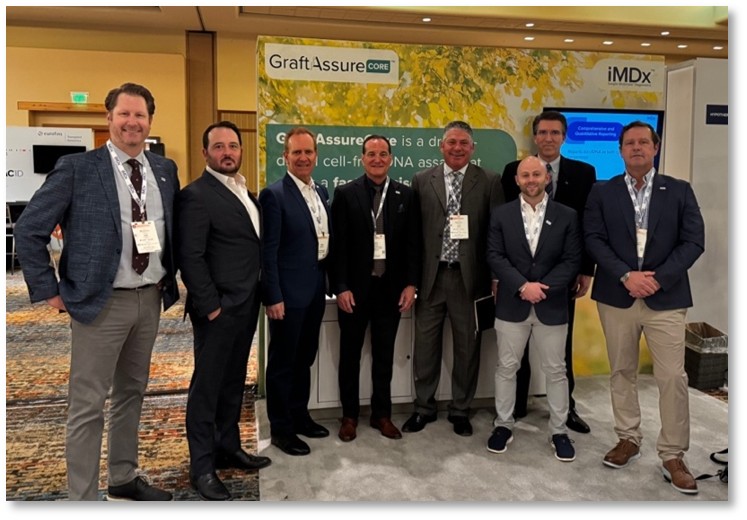
- STAR, a major industry working group, published a position paper in the American Journal of Transplantation recognizing the need for decentralized organ health testing. Yet another leading independent industry body has acknowledged that high-quality, standardized, decentralized dd-cfDNA testing is essential. Naturally we agree, and are delighted that this position paper affirms our and our shareholders’ investment thesis about the necessity for kitted transplant rejection testing. We also believe the position paper is a testament to what we believe will be high demand for what we are developing. Of note, STAR is a joint group with members from the American Society of Transplantation (AST) and the American Society for Histocompatibility and Immunogenetics (ASHI). AST and ASHI are the preeminent professional societies representing the clinicians and laboratories that serve the transplant community. STAR stands for Sensitization in Transplantation: Assessment of Risk. One of STAR’s working groups focuses on dd-cfDNA, and the above referenced publication is a conclusion from that group.
- We appointed Dr. Nick Ioannou, M.D., Ph.D., MHA, as Vice President of Medical Affairs to prepare for our commercial transplant assay launch. Dr. Ioannou brings more than three decades of experience across clinical practice, diagnostics, regulatory affairs, medical education, and medical affairs, with deep experience in organ transplant, nephrology, cardiology, genetics, and oncology. He previously served Guardant Health as a senior staff medical science liaison and field director. He has also served in several other senior medical affairs positions, including as a medical science liaison for organ health and genetics at Natera, as director of medical education and medical communications at LA Ort Institute, as director of medical affairs at L-Nutra, and as international medical science liaison for heart and kidney transplant at CSL Behring. He has also held roles at Fresenius, Baxter, and Northwestern University, among others.
Fourth Quarter and Full Year 2025 Financial Overview
- For the full year ended December 31, 2025, we reported revenue of $4.1 million compared with revenue of $1.9 million in 2024. In Q4 2025, our revenues were $1.1 million.
- Nearly all our revenues are derived from laboratory services performed at our clinical laboratory in Tennessee. Relative to our strategic goal of selling diagnostic test kits for clinical use, we remain essentially “pre-revenue.” Our laboratory services are performed at the request of select clients, and we see our laboratory services revenue as a testament to our team’s ability to achieve the on-time delivery of clear, scientifically sound, and accurate data sets to our clients.
- We did not realize any kitted product revenue in the fourth quarter. As previously communicated, we do not expect material revenue on our kitted product sales until after we have achieved regulatory authorization to market GraftAssureDx.
- Our full year gross profit of $2.3 million, at 56.7% gross margin, compares with gross profit of $740,000 a year ago, at 39.3% gross margin. We reported gross profit of $496,000 in Q4 2025, representing a 43.5% gross margin.
- On a full-year basis, 2025 operating expenses of $53.4 million included a $14.6 million in non-cash impairment losses from intangible assets, a loss of $5.9 million from a non-cash change in the fair value of our contingent consideration, as well as $2.2 million in non-cash stock-based compensation expenses, and $2.1 million in non-cash depreciation and amortization expenses. Excluding the impact of these non-cash charges, our non-GAAP 2025 operating expenses increased 37% year over year.
- Research and development expenses increased 62% year over year to $15.9 million in 2025 reflecting increased investment in our kitted product development – including FDA-compliant software development expenses, laboratory supplies, kit production, personnel and regulatory consulting fees.
- Sales and marketing expenses increased 61% year over year to $6.3 million in 2025. We continue to invest in go-to-market activities as we prepare for commercial launch, including marketing, advertising, travel, consulting fees and personnel.
- General and administrative expenses increased 4% year over year to $10.6 million in 2025, driven by cost discipline.
- In Q4 2025, operating expenses of $23.9 million included $14.6 million in non-cash impairment losses from intangible assets, a gain of $1.1 million from a non-cash change in the fair value of our contingent consideration, as well as $721,000 in non-cash stock-based compensation expenses, and $543,000 in non-cash depreciation and amortization expenses. Excluding the impact of these non-cash net charges, our non-GAAP operating expenses increased 37% sequentially over the third quarter and 84% year over year, as we invested more heavily in our FDA program ahead of commercial launch.
- In the fourth quarter, we invested in headcount to prepare to commercialize our kidney transplant assay. As expected, and projected in our November update, we also incurred incremental costs related to our FDA submission.
- The $14.6 million intangible asset impairment charge we recorded in Q4 2025 reflects our decision to maintain a minimum rate of investment in our oncology assets as we continue to focus on commercializing our kitted transplant products. Specifically, we fully impaired our oncology intangible assets and recorded a charge of $11.7 million for DetermaCNI and $2.9 million for DetermaIO. Although oncology remains a key area of future innovation for us, with broad-based valuation creation potential, the impairment charge reflects our near-term strategic focus on transplant medicine.
- In Q4 2025, research and development expenses increased 50% sequentially, or by $2.0 million, to $5.8 million, reflecting increased investment in our kitted product development.
- Q4 2025 represented higher-than-average research and development expenses as we approached FDA submission, including FDA-compliant software development expenses, laboratory supplies, kit production, personnel and costs associated with our clinical trial, including regulatory consulting fees. We expect that Q1 2026 R&D expenses will decline sequentially.
- In Q4 2025, sales and marketing expenses increased 65% sequentially to $2.3 million. We continue to invest in go-to-market activities as we prepare for commercial launch, including marketing, advertising, travel, consulting fees and personnel.
- General and administrative expenses declined 9% sequentially to $2.3 million in the fourth quarter, driven by cost discipline.
- Our Q4 2025 net loss was $23.0 million, or $0.72 net loss per share.
- Non-GAAP EPS: Our Q4 2025 adjusted net loss of $8.7 million represented a loss of $0.27 per share. Our adjusted net loss excludes the non-cash charges of stock-based compensation expenses, the change in fair value of our contingent consideration and the effect of asset impairment charges (“Non-GAAP Net Loss”).
- Non-GAAP Adjusted EBITDA: Our Q4 2025 adjusted earnings or loss before interest, income taxes, depreciation, amortization, stock-based compensation, change in fair value of contingent consideration, impairments and other non-operating items (“Adjusted EBITDA Loss”) was $8.7 million.
- As a reminder, in November we communicated our intention to retire our non-GAAP loss from operations disclosure and have introduced disclosures for Adjusted EBITDA Loss, Non-GAAP Net Loss and non-GAAP net loss per share. Please refer to the table below, “Reconciliation of Non-GAAP Financial Measures,” for additional disclosures and information.
- Our Q4 2025 per share results reflect 32.1 million weighted average shares outstanding and include the effects of 3.4 million pre-funded warrant shares that were issued in April 2024 and February 2025 to a certain investor.
- Inclusive of 3.5 million shares from our February 2026 registered direct offering, our current outstanding share count is 32.2 million. The February 2026 offering included additional pre-funded warrant shares of 1.0 million; including the effects of all outstanding pre-funded warrant shares, for purposes of per share calculations, our current weighted average shares outstanding would be approximately 36.6 million.
- Our cash, cash equivalents, and restricted cash balance at the end of the fourth quarter was $12.9 million. On February 12, 2026, we completed a $26.0 million registered direct offering, which after deducting fees the resulting net proceeds were approximately $24.6 million.
- As expected and projected in November, our fourth quarter outgoing cash flow from operations (net cash used in operating activities) of $5.5 million, combined with capital expenditures of $1.5 million, resulted in outgoing free cash flow of $7.0 million.
- In 2026, we expect to continue to be thoughtful about capital allocation, hiring, and expense growth. We expect to average cash burn of about $7.5 million per quarter in 2026 – with outgoing cash flow above $8 million per quarter in the first half, and dropping down to historical cash burn levels of $6 million per quarter in the back half.
Webcast and Conference Call Information
Live Zoom Call and Webcast on Thursday, March 26, 2026, at 2:00 p.m. PT / 5:00 p.m. ET.
Those interested may access the live Zoom call by registering here: iMDx Q4 2025 Earnings Webinar
Once registered, a confirmation email will be sent with instructions.
A replay of the Zoom call will be available on the company’s website shortly after the call.
iMDx Transplant Products and Product Candidates in Development
iMDx’s flagship transplant testing technology quantifies a molecular biomarker known as donor-derived cell-free DNA (dd-cfDNA). The company’s scientists in Germany and the U.S. have played a critical role over the past decade in developing the science that helped establish dd-cfDNA as a trusted biomarker of transplant rejection. iMDx is commercializing this technology using a market-disruptive business strategy. Under the GraftAssure™ brand, iMDx’s transplant diagnostics include the following:
- GraftAssureCore – The company’s laboratory-developed test (LDT), currently reimbursed by CMS and performed at iMDx’s CLIA-certified laboratory in Franklin, Tennessee.
- GraftAssureIQ – A research-use-only (RUO) kit intended and labeled for non-clinical applications.
- GraftAssureDx – The in vitro diagnostic (IVD) kit currently in development for use in clinical decision-making.
About Insight Molecular Diagnostics, Inc.
Insight Molecular Diagnostics is a pioneering diagnostics technology company whose mission is to democratize access to novel molecular diagnostic testing to improve patient outcomes. Investors may visit https://investors.imdxinc.com/ for more information.
GraftAssureCore™, GraftAssureIQ™, GraftAssureDx™, GraftAssure™, DetermaIO™, and DetermaCNI™ are trademarks of Insight Molecular Diagnostics Inc.
Forward-Looking Statements
Any statements that are not historical fact (including, but not limited to, statements that contain words such as “will,” “believes,” “plans,” “anticipates,” “expects,” “estimates,” “may,” and similar expressions) are forward-looking statements. These statements include those pertaining to, among other things, demand for iMDx’s products and what the company is building, the expectation that decentralized testing will deliver new value in the roughly $2 billion-plus addressable market for kitted transplant rejection testing, the company’s competitive advantage and path to supplying the world’s most widely used dd-cfDNA assay, iMDx’s expectations for FDA review and authorization and its 2026 goals (including but not limited to commercial, regulatory and R&D goals), management’s thoughts on where transplant patient management is headed and why the company is well-positioned, emerging clinical utility of dd-cfDNA testing, the belief that democratizing access to transplanted organ rejection testing creates a rapidly growing, high-margin, recurring business model, and other statements about the future expectations, beliefs, goals, plans, or prospects expressed by management. Forward-looking statements involve risks and uncertainties, including, without limitation, risks inherent in the development and/or commercialization of diagnostic tests or products, uncertainty in the results of clinical trials or regulatory approvals, the capacity of Insight Molecular Diagnostics’ third-party supplied blood sample analytic system to provide consistent and precise analytic results on a commercial scale, potential interruptions to supply chains, the need and ability to obtain future capital, maintenance of intellectual property rights in all applicable jurisdictions, obligations to third parties with respect to licensed or acquired technology and products, the need to obtain third party reimbursement for patients’ use of any diagnostic tests Insight Molecular Diagnostics or its subsidiaries commercialize in applicable jurisdictions, and risks inherent in strategic transactions such as the potential failure to realize anticipated benefits, legal, regulatory or political changes in the applicable jurisdictions, accounting and quality controls, potential greater than estimated allocations of resources to develop and commercialize technologies, or potential failure to maintain any laboratory accreditation or certification. Actual results may differ materially from the results anticipated in these forward-looking statements and accordingly such statements should be evaluated together with the many uncertainties that affect the business of Insight Molecular Diagnostics, particularly those mentioned in the “Risk Factors” and other cautionary statements found in Insight Molecular Diagnostics’ Securities and Exchange Commission (SEC) filings, which are available from the SEC’s website. You are cautioned not to place undue reliance on forward-looking statements, which speak only as of the date on which they were made. Insight Molecular Diagnostics undertakes no obligation to update such statements to reflect events that occur or circumstances that exist after the date on which they were made, except as required by law.
Investor Contact:
Alexandra Grossman
LifeSci Advisors LLC
alex@lifesciadvisors.com
Tables Follow
INSIGHT MOLECULAR DIAGNOSTICS INC.
CONSOLIDATED BALANCE SHEETS
(In thousands)
| December 31, | ||||||||
| 2025 | 2024 | |||||||
| ASSETS | ||||||||
| CURRENT ASSETS | ||||||||
| Cash and cash equivalents | $ | 11,583 | $ | 8,636 | ||||
| Accounts receivable, net of allowance for credit losses of $11 and $16, respectively | 1,128 | 1,613 | ||||||
| Inventories | 446 | 410 | ||||||
| Deferred financing costs | — | 279 | ||||||
| Restricted cash, current | 729 | — | ||||||
| Prepaid expenses and other current assets | 1,420 | 821 | ||||||
| Total current assets | 15,306 | 11,759 | ||||||
| NONCURRENT ASSETS | ||||||||
| Right-of-use operating and financing lease assets, net | 2,815 | 2,757 | ||||||
| Machinery and equipment, net, and construction in progress | 6,435 | 3,567 | ||||||
| Intangible assets, net | — | 14,607 | ||||||
| Restricted cash, noncurrent | 607 | 1,700 | ||||||
| Other noncurrent assets | 593 | 691 | ||||||
| TOTAL ASSETS | $ | 25,756 | $ | 35,081 | ||||
| LIABILITIES AND SHAREHOLDERS’ DEFICIT | ||||||||
| CURRENT LIABILITIES | ||||||||
| Accounts payable | $ | 2,544 | $ | 1,641 | ||||
| Due to related party | 2,780 | 638 | ||||||
| Accrued compensation | 2,461 | 1,939 | ||||||
| Accrued royalties | 1,116 | 1,116 | ||||||
| Accrued expenses and other current liabilities | 939 | 418 | ||||||
| Operating and financing lease liabilities, current | 1,807 | 1,295 | ||||||
| Contingent consideration liabilities, current | 428 | 228 | ||||||
| Total current liabilities | 12,075 | 7,275 | ||||||
| NONCURRENT LIABILITIES | ||||||||
| Operating and financing lease liabilities, noncurrent | 1,690 | 2,369 | ||||||
| Contingent consideration liabilities, noncurrent | 43,455 | 37,711 | ||||||
| TOTAL LIABILITIES | 57,220 | 47,355 | ||||||
| Commitments and contingencies | ||||||||
| SHAREHOLDERS’ DEFICIT | ||||||||
| Preferred stock, no par value, 5,000 shares authorized; no shares issued and outstanding | — | — | ||||||
| Common stock, no par value, 230,000 shares authorized; 28,683 and 17,453 shares issued and outstanding at December 31, 2025 and 2024, respectively | 369,211 | 338,244 | ||||||
| Accumulated other comprehensive income | 86 | 21 | ||||||
| Accumulated deficit | (400,761 | ) | (350,539 | ) | ||||
| Total shareholders’ deficit | (31,464 | ) | (12,274 | ) | ||||
| TOTAL LIABILITIES AND SHAREHOLDERS’ DEFICIT | $ | 25,756 | $ | 35,081 | ||||
INSIGHT MOLECULAR DIAGNOSTICS INC.
UNAUDITED CONSOLIDATED STATEMENTS OF OPERATIONS
(In thousands, except per share data)
| Three Months Ended December 31, | Years Ended December 31, | |||||||||||||||
| 2025 | 2024 | 2025 | 2024 | |||||||||||||
| Net revenue | $ | 1,139 | $ | 1,486 | $ | 4,055 | $ | 1,881 | ||||||||
| Cost of revenues | 643 | 869 | 1,750 | 1,053 | ||||||||||||
| Cost of revenues – amortization of acquired intangibles | — | 22 | 7 | 88 | ||||||||||||
| Gross profit | 496 | 595 | 2,298 | 740 | ||||||||||||
| Operating expenses: | ||||||||||||||||
| Research and development | 5,829 | 2,257 | 15,900 | 9,839 | ||||||||||||
| Sales and marketing | 2,291 | 1,202 | 6,343 | 3,944 | ||||||||||||
| General and administrative | 2,326 | 2,559 | 10,633 | 10,204 | ||||||||||||
| Change in fair value of contingent consideration | (1,115 | ) | (13,696 | ) | 5,946 | (4,275 | ) | |||||||||
| Impairment losses | 14,600 | 41,900 | 14,600 | 41,900 | ||||||||||||
| Impairment loss on held for sale assets | — | — | — | 169 | ||||||||||||
| Total operating expenses | 23,931 | 34,222 | 53,422 | 61,781 | ||||||||||||
| Loss from operations | (23,435 | ) | (33,627 | ) | (51,124 | ) | (61,041 | ) | ||||||||
| Other (expenses) income: | ||||||||||||||||
| Interest expense | (26 | ) | (30 | ) | (109 | ) | (84 | ) | ||||||||
| Other income, net | 506 | 146 | 1,011 | 462 | ||||||||||||
| Total other income, net | 480 | 116 | 902 | 378 | ||||||||||||
| Loss before income taxes | (22,955 | ) | (33,511 | ) | (50,222 | ) | (60,663 | ) | ||||||||
| Income taxes | — | — | — | — | ||||||||||||
| Net loss | $ | (22,955 | ) | $ | (33,511 | ) | $ | (50,222 | ) | $ | (60,663 | ) | ||||
| Net loss per share: | ||||||||||||||||
| Net loss attributable to common stockholders - basic and diluted | $ | (22,955 | ) | $ | (33,511 | ) | $ | (50,222 | ) | $ | (60,926 | ) | ||||
| Net loss attributable to common stockholders per share - basic and diluted | $ | (0.72 | ) | $ | (1.93 | ) | $ | (1.65 | ) | $ | (4.66 | ) | ||||
| Weighted average shares outstanding - basic and diluted | 32,065 | 17,382 | 30,476 | 13,071 | ||||||||||||
INSIGHT MOLECULAR DIAGNOSTICS INC.
UNAUDITED CONSOLIDATED STATEMENTS OF CASH FLOWS
(In thousands)
| Three Months Ended December 31, | Years Ended December 31, | |||||||||||||||
| 2025 | 2024 | 2025 | 2024 | |||||||||||||
| CASH FLOWS FROM OPERATING ACTIVITIES: | ||||||||||||||||
| Net loss | $ | (22,955 | ) | $ | (33,511 | ) | $ | (50,222 | ) | $ | (60,663 | ) | ||||
| Adjustments to reconcile net loss to net cash used in operating activities: | ||||||||||||||||
| Depreciation and amortization expense | 563 | 541 | 2,190 | 1,476 | ||||||||||||
| Amortization of intangible assets | — | 22 | 7 | 88 | ||||||||||||
| Stock-based compensation | 721 | 499 | 2,219 | 1,753 | ||||||||||||
| Equity compensation for bonus awards and consulting services | 38 | 50 | 164 | 160 | ||||||||||||
| Change in fair value of contingent consideration | (1,115 | ) | (13,696 | ) | 5,946 | (4,275 | ) | |||||||||
| Impairment losses | 14,600 | 41,900 | 14,600 | 41,900 | ||||||||||||
| Impairment loss on held for sale assets | — | — | — | 169 | ||||||||||||
| Unrealized foreign currency losses (gains) | 15 | (33 | ) | 185 | (4 | ) | ||||||||||
| Changes in operating assets and liabilities: | ||||||||||||||||
| Accounts receivable | (870 | ) | (1,404 | ) | 485 | (1,129 | ) | |||||||||
| Inventories | 25 | (178 | ) | (36 | ) | (410 | ) | |||||||||
| Prepaid expenses and other assets | (102 | ) | (77 | ) | (226 | ) | (430 | ) | ||||||||
| Accounts payable and accrued liabilities | 3,555 | 704 | 2,646 | 967 | ||||||||||||
| Operating lease assets and liabilities | (20 | ) | (168 | ) | (142 | ) | (291 | ) | ||||||||
| Net cash used in operating activities | (5,545 | ) | (5,351 | ) | (22,184 | ) | (20,689 | ) | ||||||||
| CASH FLOWS FROM INVESTING ACTIVITIES: | ||||||||||||||||
| Proceeds from sale of equipment | — | 4 | — | 4 | ||||||||||||
| Machinery and equipment purchases, and construction in progress | (1,479 | ) | (214 | ) | (3,185 | ) | (516 | ) | ||||||||
| Net cash used in investing activities | (1,479 | ) | (210 | ) | (3,185 | ) | (512 | ) | ||||||||
| CASH FLOWS FROM FINANCING ACTIVITIES: | ||||||||||||||||
| Proceeds from sale of common shares | — | 10,205 | 29,143 | 26,012 | ||||||||||||
| Financing costs to issue common shares | — | (836 | ) | (487 | ) | (1,374 | ) | |||||||||
| Proceeds from sale of common shares under at-the-market transactions | — | 1,784 | — | 1,802 | ||||||||||||
| Financing costs for at-the-market sales | — | (234 | ) | — | (421 | ) | ||||||||||
| Redemption of Series A redeemable convertible preferred shares | — | — | — | (5,389 | ) | |||||||||||
| Contingent consideration liability payments | (2 | ) | — | (2 | ) | — | ||||||||||
| Taxes paid related to net share settlement of stock-based awards | (72 | ) | — | (72 | ) | — | ||||||||||
| Repayment of financing lease obligations | (178 | ) | (82 | ) | (510 | ) | (201 | ) | ||||||||
| Net provided by financing activities | (252 | ) | 10,837 | 28,072 | 20,429 | |||||||||||
| Effect of exchange rate changes on cash and cash equivalents | (15 | ) | (3 | ) | (120 | ) | (24 | ) | ||||||||
| NET CHANGE IN CASH, CASH EQUIVALENTS AND RESTRICTED CASH | (7,291 | ) | 5,273 | 2,583 | (796 | ) | ||||||||||
| CASH, CASH EQUIVALENTS AND RESTRICTED CASH, BEGINNING | 20,210 | 5,063 | 10,336 | 11,132 | ||||||||||||
| CASH, CASH EQUIVALENTS AND RESTRICTED CASH, ENDING | $ | 12,919 | $ | 10,336 | $ | 12,919 | $ | 10,336 | ||||||||
INSIGHT MOLECULAR DIAGNOSTICS INC.
RECONCILIATION OF NON-GAAP FINANCIAL MEASURES
NON-GAAP NET LOSS AND ADJUSTED EBITDA LOSS
In addition to financial results determined in accordance with U.S. generally accepted accounting principles (“GAAP”), this press release also includes non-GAAP financial measures (as defined under SEC Regulation G). We believe that disclosing the adjusted amounts is helpful in assessing our ongoing performance, providing insight into the Company’s core operating performance by excluding certain non-cash and other non-operating items that may obscure the underlying trends in the business. These non-GAAP financial measures, when viewed in a reconciliation to respective GAAP financial measures, provide an additional way of viewing the Company’s results of operations and factors and trends affecting the Company’s business. These non-GAAP financial measures should be considered as a supplement to, and not as a substitute for, or superior to, the respective financial results presented in accordance with GAAP.
The following is a reconciliation of the non-GAAP financial measures to the most directly comparable GAAP measure:
| Three Months Ended December 31, | Years Ended December 31, | |||||||||||||||
| 2025 | 2024(1) | 2025 | 2024(1) | |||||||||||||
| (unaudited) | (unaudited) | (unaudited) | (unaudited) | |||||||||||||
| (In thousands) | ||||||||||||||||
| Net loss (GAAP) | $ | (22,955 | ) | $ | (33,511 | ) | $ | (50,222 | ) | $ | (60,663 | ) | ||||
| Stock-based compensation | 721 | 499 | 2,219 | 1,753 | ||||||||||||
| Change in fair value of contingent consideration | (1,115 | ) | (13,696 | ) | 5,946 | (4,275 | ) | |||||||||
| Impairment losses | 14,600 | 41,900 | 14,600 | 41,900 | ||||||||||||
| Impairment loss on held for sale assets | — | — | — | 169 | ||||||||||||
| Non-GAAP net loss | (8,749 | ) | (4,808 | ) | (27,457 | ) | (21,116 | ) | ||||||||
| Depreciation and amortization expenses | 563 | 563 | 2,197 | 1,564 | ||||||||||||
| Interest expense | 26 | 30 | 109 | 84 | ||||||||||||
| Other income, net | (506 | ) | (146 | ) | (1,011 | ) | (462 | ) | ||||||||
| Income taxes | — | — | — | — | ||||||||||||
| Adjusted EBITDA loss, a non-GAAP financial measure | $ | (8,666 | ) | $ | (4,361 | ) | $ | (26,162 | ) | $ | (19,930 | ) | ||||
| Net loss per share (GAAP) | $ | (0.72 | ) | $ | (1.93 | ) | $ | (1.65 | ) | $ | (4.66 | ) | ||||
| Non-GAAP net loss per share | $ | (0.27 | ) | $ | (0.28 | ) | $ | (0.90 | ) | $ | (1.62 | ) | ||||
| Weighted average shares outstanding | 32,065 | 17,382 | 30,476 | 13,071 | ||||||||||||
(1) The 2024 reconciliation line-items have been presented to conform to the 2025 presentation. The newly titled total “Adjusted EBITDA loss, a non-GAAP financial measure” reported for 2024 is unchanged from the 2024 “Consolidated non-GAAP loss from operations, as adjusted” as previously reported.
A photo accompanying this announcement is available at https://www.globenewswire.com/NewsRoom/AttachmentNg/e0ce40a4-4256-401d-bfee-5688340631a5