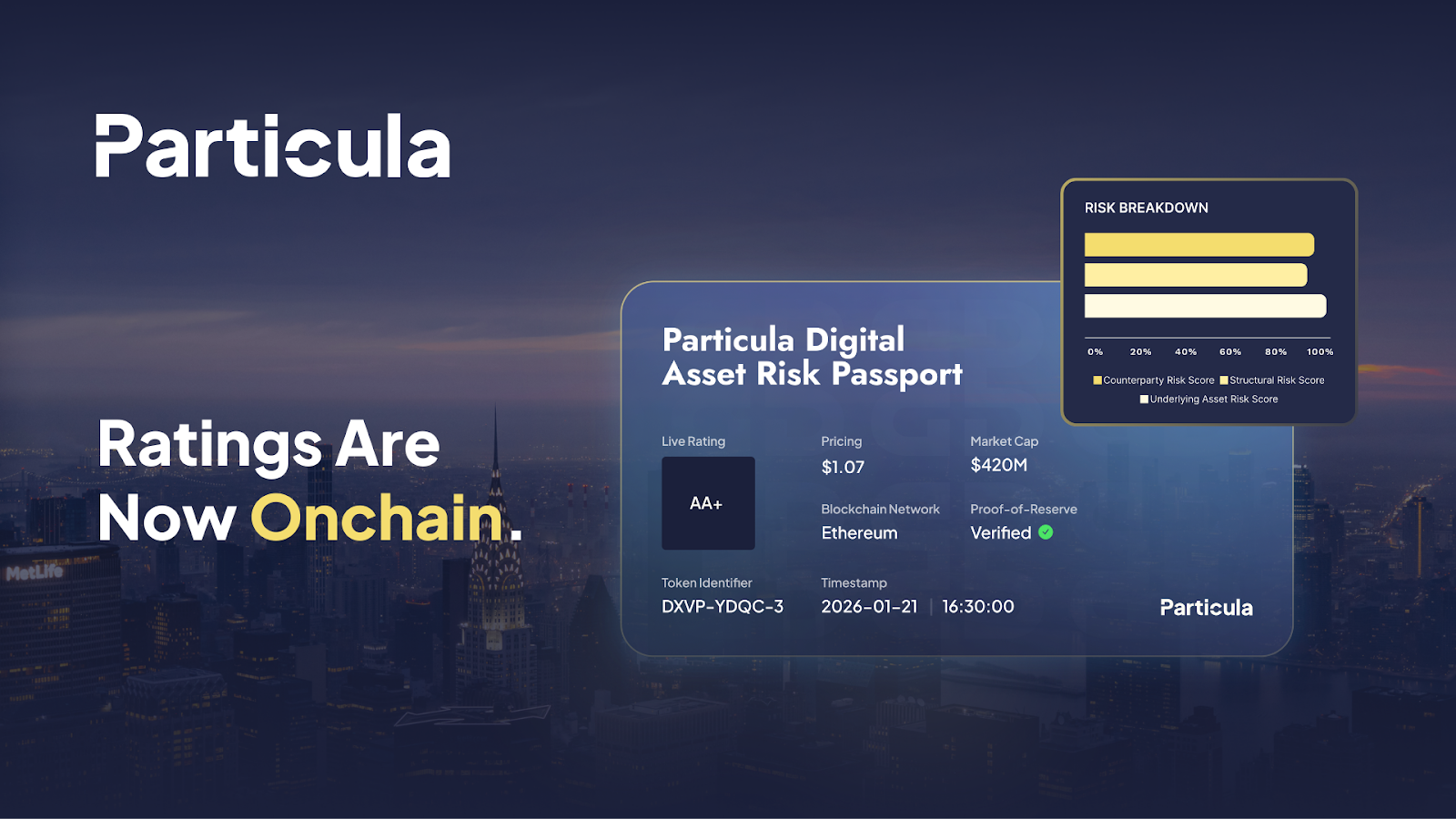
| Photo Courtesy of Particula |
NEW YORK, March 23, 2026 (GLOBE NEWSWIRE) -- Particula just announced the launch of the Particula Digital Asset Risk Passport (PDARP), a programmable, omnichain risk credential designed to make risk assessments machine-readable, continuously updated, and directly usable by smart contracts.
Tokenized financial and real-world assets are scaling quickly, yet the risk layer supporting them is still largely offchain, static, and non-executable. PDARP closes that gap by turning Particula’s risk ratings into onchain infrastructure that protocols can query and enforce in real time.
“Institutional capital won’t move onchain at scale until risk is as transparent and composable as the assets themselves,” said Timm Reinsdorf, Co-Founder & CEO of Particula. “We’ve spent years rating tokenized assets across structures, jurisdictions, and asset classes. Now we’re encoding that expertise directly onchain. The Risk Passport makes ratings and associated metadata interoperable and executable for the next wave of digital capital markets.”
The Bottleneck: Risk Remains Offchain While Assets Move Onchain
Financial and real-world assets are moving onto public blockchains at an accelerating pace, and institutional capital is beginning to follow. But most risk assessments today are still delivered as PDFs, reports, and dashboards that smart contracts cannot verify or act on.
That creates structural blind spots:
- A protocol can’t programmatically confirm an asset’s current risk profile
- There’s no native mechanism to detect whether a material risk event occurred since the last report
- Collateral and listing decisions are often based on stale, offchain information, even as the asset itself is actively used onchain
- Liquidity providers and automated pools have no reliable way to price risk into spreads, haircuts, or collateral parameters, so liquidity is either withheld or mispriced
As tokenized markets scale, these gaps become more consequential, limiting liquidity formation, increasing the risk of mispriced collateral, and slowing institutional adoption.
From Credit Risk to Tokenization Risk: The Framework Behind the Passport (PDARF)
Traditional credit ratings were designed to estimate default probability on debt instruments. That lens remains essential in digital finance, but tokenized assets introduce additional, system-critical risk factors that conventional ratings were never built to capture: smart contract vulnerabilities, oracle and dependency risk, cross-chain fragmentation, novel custody and control arrangements, and the gap between what offering documents promise and what is verifiable onchain.
The Particula Digital Asset Risk Framework (PDARF) extends the traditional credit lens to reflect how tokenized assets execute in production. PDARF evaluates risk across counterparty risk, structural risk, and underlying risk, and maps those pillars into a comprehensive set of dimensions including legal and regulatory context, asset and reserve quality, governance and operations, technology dependencies, market liquidity, and custody arrangements.
PDARP is the onchain delivery layer of PDARF; turning this framework into a programmable credential smart contracts can query and enforce without manual governance cycles.
What the Digital Asset Risk Passport Publishes Onchain
PDARP publishes standardized risk signals and metadata onchain across five core categories:
| Category | Examples of Data Points |
| Live Rating | Scores, Sub-Scores, Rating History, Red Flags, Alerts |
| Pricing | Price Discovery Signals, Liquidity Metrics, Valuation Inputs |
| Proof-of-Reserve | Reserve Verification, Attestation Status, Assurance Level |
| Lifecycle | Issuance History, Token & Asset Identifiers, Control Mechanisms |
| Alerts | Security Events, Compliance Changes, Performance Triggers |
Passport data is designed to be updated continuously, with immediate updates triggered by critical events such as rating changes or red flag escalations.
Omnichain, Programmable, and Built for DeFi Integration
PDARP is designed to operate natively across onchain capital markets, not on a single network or in a single application.
- Omnichain availability: PDARP is available across 30+ EVM networks (including Ethereum, Arbitrum, Optimism, Base, BNB Chain, and others) as well as non-EVM ecosystems including Solana, Aptos, and Stellar; enabling protocols to query standardized risk credentials wherever tokenized assets are issued and used.
- Deployment-specific calibration: When an asset is deployed across multiple networks, each deployment can carry a corresponding credential calibrated to chain-specific parameters - reflecting differences in smart contract infrastructure, network maturity, and ecosystem liquidity - while remaining queryable onchain in real time.
Because the Passport is machine-readable, protocols can move from risk awareness to risk enforcement. Through modular guard contracts, Passport signals can be translated into automated controls such as:
- Circuit breakers to pause deposits or withdrawals when red flags trigger
- Dynamic collateral parameters to adjust LTV ratios as ratings change
- Lifecycle alerts to support orderly unwinds as assets approach key events
- Liquidation triggers to initiate risk reduction before critical thresholds are breached
- Access controls to gate pool or vault participation based on minimum rating requirements
These capabilities unlock applications across onchain capital markets, including:
- Lending & borrowing with collateral parameters tied to live risk signals
- Vaults & indices with automated rebalancing governed by risk thresholds
- Listings & marketplaces with rating-gated, curated asset pools
- Insurance with parametric pricing driven by continuously updated risk data
- Derivatives with embedded monitoring of counterparty and underlying risk in contract logic
As financial automation accelerates - from algorithmic treasury operations to autonomous agents - these systems will not read PDFs or call analysts. They will query standardized, continuously updated onchain risk credentials to make decisions in real time.
Who PDARP is for
PDARP provides a shared, onchain risk credential that different market participants can use to standardize due diligence and automate risk controls.
- DeFi Protocols (Lending/Borrowing, DEXs, Vaults, Collateral Managers)
Integrate live risk data directly into smart contract logic. Automate risk responses without manual governance intervention. Meet institutional expectations for transparency and risk controls that help unlock larger capital flows.
- Allocators (Institutional Investors, DAOs, Treasuries)
Move from quarterly PDF reports to continuous, onchain-verifiable due diligence. One standardized framework, real-time alerts, and comparability across tokenized assets in a portfolio.
- Issuers (Asset Managers, Tokenization Platforms)
Gain third-party, institutional-grade risk assessment. Enable tokenized assets to participate in DeFi with full risk transparency and potentially more attractive economic terms that credible, independently verifiable risk data can support.
- Custodians & Service Providers (Custodians, Attestation/Audit Firms, Data and Compliance Providers)
Monitor assets against standardized risk signals, strengthen reporting and oversight, and integrate Passport data into operational controls and institutional workflows.
Getting involved
Protocols and issuers interested in integrating PDARP, rating assets, or exploring partnerships can reach Particula at info@particula.io.
Contact Information:
Contact Person: Nadine Wilke, Co-Founder & CGO at Particula
Email Address: info@particula.io
Website: www.particula.io
Address: New Jersey, USA
A photo accompanying this announcement is available at https://www.globenewswire.com/NewsRoom/AttachmentNg/602308fa-a101-4c32-acee-b402b525de1c
