SAN FRANCISCO, March 19, 2026 (GLOBE NEWSWIRE) -- Keycard, the provider of identity and access for AI agents, today released Keycard for Coding Agents, giving security and platform teams the tools they need to unleash true autonomous coding workflows across their organization without sacrificing security or enablement. Keycard for Coding Agents builds on the Keycard platform, now in production, and is integrated with every major coding agent including those created by OpenAI, Anthropic, Cursor and popular open source offerings like OpenClaw and OpenCode.
Keycard will be showcasing Keycard for Coding Agents in its booth #2351 at Moscone South Expo at RSA.
"We wanted our engineers deploying agents and tools into production without needing to be security or identity experts. Keycard's platform made that possible. We had agents running against production systems in days,” said Dennis Yang, Principal Product Manager for Generative AI at Chime.
“Coding agents have crossed from autocomplete into true autonomy, but most organizations aren’t ready for the implications. Enterprises are rapidly adopting multiple agents across repositories, each requiring its own configuration and governance, creating operational complexity at scale. At the same time, security and platform teams are struggling to keep up with a new class of software actor, agents that can act without human oversight, access sensitive data, invoke tools unpredictably and introduce subtle but significant risks. Without stronger guardrails and visibility, organizations risk losing control over how software is built and modified,” said Paul Nashawaty, Principal Analyst at theCUBE and ECI Research.
“As industries continue to explore the potential of agentic AI workforces, especially agentic software development and coding, we must proceed with caution. Without proper guardrails, agentic AI hallucinations can not only introduce new attack vectors into an enterprise but also hold significant potential to negatively affect productivity and business operations,” said Ken Buckler, Research Director at EMA.
Coding agents crossed from autocomplete to true autonomy last year but security and platform teams are struggling to keep up with their mass adoption. Every organization is adopting multiple agents simultaneously, each requiring its own configuration per repository, making setup and enablement at scale a growing challenge. Meanwhile, security teams are struggling to manage the risk explosion that agents represent, reasoning without human oversight, reading credentials from the environment or any file on disk, invoking unintended tools and making changes that appear innocuous at first glance.
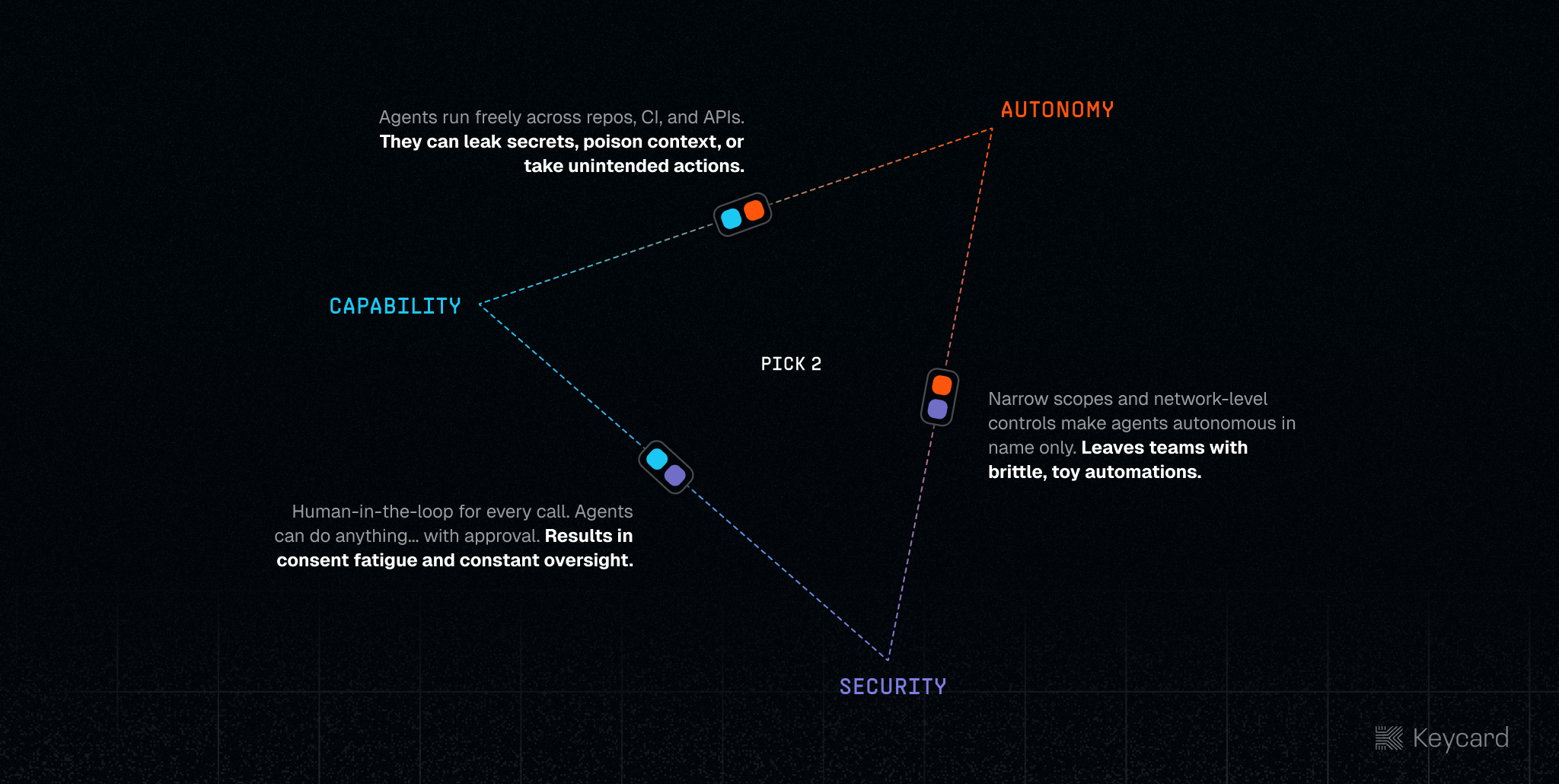
The result is a familiar tradeoff between autonomy, capability and security. Teams enabling agents across the organization are forced to pick two and constrain the third, and they have to make that tradeoff differently for every agent, every repository and every team. Most often, they fall back to human-in-the-loop workflows that require developers to approve every tool call, destroying all semblance of autonomy and exhausting users through consent fatigue providing a false sense of security. The productivity gains these agents unlock stays theoretical instead of deployed at scale in production.
"The agents writing code today are the ones rebuilding our applications and workflows to be agent native. Govern the coding workflow and you govern the factory floor. That's what Keycard for Coding Agents does: runtime controls on every tool call, every credential, every action, so developers can experience autonomy instead of approving every tool call," said Ian Livingstone, co-founder and CEO of Keycard.
Keycard for Coding Agents solves these trade-offs by enabling teams to roll out agents with a single configuration from a centralized control plane while ensuring agents only have access to use approved tools based on the identity of the agent, the user and the task they’ve been assigned. Keycard intelligently brings the human into the loop only when required, ensuring agents can work autonomously without compromising security or requiring one-off configurations.
Under the hood, Keycard for Coding Agents integrates with the agent and its hook system ensuring policy enforcement and telemetry collection across the agent and tool calling lifecycle. This means an agent can only perform an action and be issued credentials if all policy requirements are met at runtime, ensuring an agent never has access to tools or systems that are out of bounds of its currently assigned task and operating context. Keycard for Coding Agents’ capabilities include:
- Identity-bound, task-scoped credentials. Static secrets are replaced with short-lived credentials cryptographically bound to the agent, the developer, the runtime environment and the task. Credentials are injected in-memory, never touch disk or the agent's context window and are gone when the session ends.
- Policy enforcement on every tool. Every tool an agent touches: shell commands, MCP servers, CLIs, APIs and code the agent writes itself at runtime is governed at the point of execution, not at login or the network boundary.
- Explicit tool governance with full visibility. Teams define which tools an agent is allowed to use. Every prompt, tool invocation and policy applied independent of success or failure is logged and attributed to a specific agent, developer, runtime and task all available in near-realtime. Shell, MCP and credential events stream to the SIEM as a single audit trail attested to the identities involved.
- Portable agent configuration across environments. Agents are configured once and run across laptops, sandboxes and CI without reconfiguration, using cryptographically attested runtime context. One policy vocabulary across coding and custom-built agents. Onboarding is a single command: keycard run and the agent is able to start work without any other configuration.
- Autonomous workflows with built-in guardrails. Routine actions proceed without human involvement. Sensitive operations deploying to production, accessing restricted data trigger real-time step-up approval from the developer. No consent fatigue. No dangerously-skip-permissions. Define it once in policy, and it applies across every agent, every repo, every machine.
- Support across cloud, SaaS and internal services. Keycard's catalog covers the long tail of services agents need to reach from cloud providers to SaaS platforms, internal APIs, databases and custom built services. Powered by OAuth 2.1, OIDC, SPIFFE and more, services that support delegation are federated directly; legacy systems with static credentials are brokered. No vendor-by-vendor connector work. If a path exists, Keycard can govern it.
- Build agents and tools with the Keycard SDK. The same identity resolution, credential issuance, policy enforcement and telemetry that powers keycard run is available as primitives. Build custom agents, skills, internal APIs or MCP servers and any coding agent governed by Keycard can access them with the same policy evaluation and audit trail as any first-party integration.
Keycard for Coding Agents is built on the Keycard platform and powered by the Keycard SDKs enabling anyone to extend Keycard for Coding Agents to support their custom made agents and any popular harnesses, giving security, developers and platform teams a single system for building and governing agents as they transform the way they work and the products they build to be agent native.
About Keycard
Keycard’s mission is to unlock the power of AI agents by giving developers and enterprises the foundations they need to build and adopt trusted agentic applications at scale. Its identity and access platform provides real-time, contextual guardrails, enabling the transition from static, human-driven workflows to machine-driven, autonomous, agentic applications. Keycard is a remote-first company and backed by Andreessen Horowitz, boldstart ventures and Acrew Capital. For more information, visit: https://www.keycard.ai.
Media and Analyst Contact:
Amber Rowland
amber@therowlandagency.com
+1-650-814-4560
A photo accompanying this announcement is available at https://www.globenewswire.com/NewsRoom/AttachmentNg/2e34bfc2-b9b1-44fd-a176-f510240c0bd5