NEW YORK, Feb. 16, 2026 (GLOBE NEWSWIRE) -- Sublistar today announced insights into emerging shifts in DTF printing production, based on analysis of global sales data, customer requirements, and recent industry events. As DTF printing moves beyond early-stage adoption, the company has identified growing constraints around production scalability, color consistency, labor efficiency, and environmental compliance. According to Sublistar, these challenges are reshaping how DTF production systems are designed and deployed, accelerating demand for multi-head platforms, expanded color capability, powderless DTF processes, and integrated workflow automation. The company stated that these trends are guiding its ongoing product and system strategy for production-oriented DTF solutions aimed at improving stability, efficiency, and long-term operational reliability.
Multi-Head DTF Platforms to Improve Production Efficiency and Flexibility
As DTF printing production scales, Sublistar has identified production efficiency, operational stability, and configuration flexibility as key requirements among customers moving beyond entry-level systems. Early two-head configurations, while suitable for initial adoption, often limit throughput and leave little room for adapting to changing order profiles or color demands. In response, Sublistar has expanded its multi-head DTF production platforms to support higher-volume output while maintaining consistent performance over extended runs. According to the company, seven- and eight-head configurations are now in active deployment, enabling production environments to increase throughput, reduce interruptions, and flexibly allocate printheads to different color schemes based on application needs. This modular approach allows manufacturers to balance efficiency and customization without sacrificing day-to-day production stability.
Expanded Color Capabilities Become a Competitive Requirement
As color accuracy and visual consistency become increasingly critical in brand-driven apparel production, Sublistar has observed growing demand for advanced multi-color DTF configurations beyond standard CMYK + W setups. Applications such as sportswear, promotional graphics, and licensed merchandise place greater emphasis on color differentiation and repeatability, requiring production systems that deliver consistent output under real operating conditions. To support these requirements, Sublistar has expanded its multi-color DTF platforms and subjected selected systems to independent third-party evaluation by Keypoint Intelligence. According to the company, its multi-color DTF solutions have met the certification criteria established by Keypoint Intelligence, confirming performance in areas such as color consistency and output stability under production conditions. Sublistar stated that obtaining third-party certification provides an objective reference point for customers as multi-color DTF moves from experimental use toward more standardized, brand-sensitive production environments.

Powderless DTF Systems in Response to Sustainability and Production Challenges
Through daily sales engagement and after-sales support, Sublistar has observed a growing number of DTF producers—particularly in European markets—placing greater emphasis on environmental compliance, workplace conditions, and material handling. Concerns around powder residue, odor, and sustainability have increasingly influenced purchasing decisions, prompting the company to accelerate the development of powderless DTF systems as an alternative to traditional powder-based workflows.
However, Sublistar noted that practical implementation revealed a different set of challenges. Without powder, adhesive behavior becomes far more sensitive to mechanical and process consistency. Insufficient machine flatness can cause adhesive flow and image distortion, while compatibility between ink and adhesive formulations plays a critical role in long-term stability. At the same time, nozzle clogging risk increases, placing higher demands on printhead management and overall system reliability.
“Powderless DTF is often seen as a simpler or cleaner solution, but in real production environments it actually requires tighter control across the entire system,” said Sarah, Director at Sublistar. “Flatness, feeding accuracy, material compatibility, and curing consistency all become decisive factors once powder is removed from the process.”
Based on more than three years of development and field validation, Sublistar has since introduced powderless DTF systems designed to address these constraints under production conditions. According to the company, its latest powderless DTF printers have achieved stable adhesive jetting behavior and controlled curing performance suitable for continuous operation. Finished prints have successfully passed internal durability testing of up to 50 wash cycles, delivering consistent adhesion performance and a softer hand feel compared with conventional powder-based DTF output.
Integrated DTF Workflow Automation to Reduce Labor Dependency
Through ongoing sales engagement and customer support, Sublistar has identified labor cost as one of the most significant constraints affecting DTF production profitability, particularly in European and North American markets where manual labor expenses remain high. While DTF printing technology itself has matured rapidly, downstream processes, especially heat pressing, have continued to rely heavily on manual operation, limiting scalability and increasing operational risk.
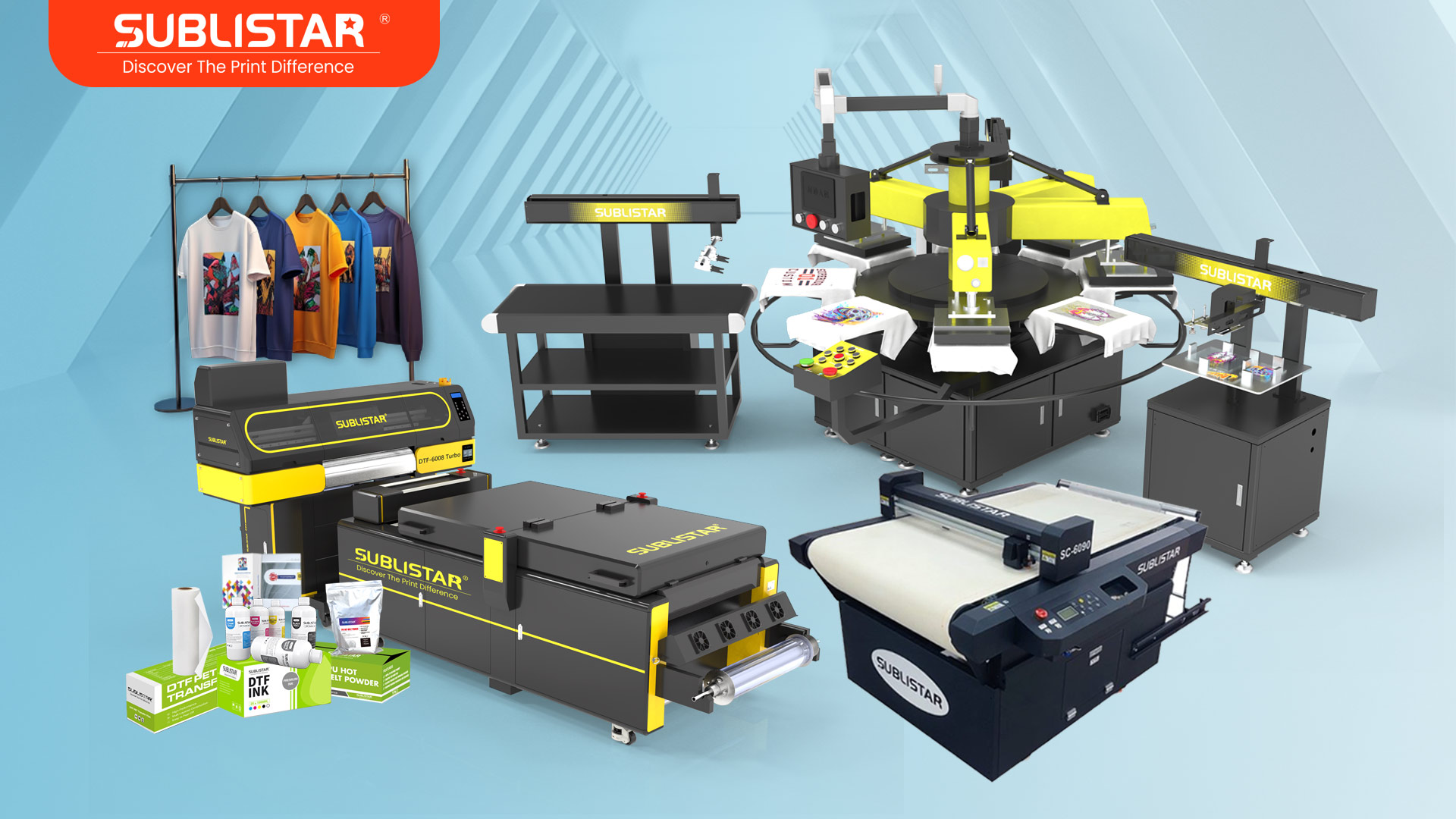
In response, Sublistar has strategically expanded its automation roadmap across the DTF workflow solution, integrating printing systems, cutting equipment, and automated heat-pressing solutions into a more connected production process. According to the company, reducing manual handoffs between individual steps has been a central design objective, with a particular focus on automating post-print handling and transfer application stages.
Sublistar stated that these efforts have resulted in measurable gains in production efficiency while significantly lowering labor requirements across the workflow. Automation has been most impactful at the heat pressing stage, where the company has introduced patented multi-station automated heat press systems designed to replace a large portion of traditional manual operations. By shifting heat pressing from labor-intensive, step-by-step handling to automated, multi-station processing, production environments can maintain higher throughput with fewer operators, improving consistency while reducing dependence on skilled manual labor.
Other Supporting Systems to Improve Operational Predictability
In addition to hardware and workflow development, Sublistar is continuing to invest in supporting systems aimed at improving day-to-day production predictability. These efforts include the expansion of automated maintenance functions designed to reduce downtime and operator dependence, the development of consumables engineered to work consistently with specific machine configurations, and software tools that provide real-time visibility into production status and workflow progress. According to the company, these complementary systems are intended to reduce variability, support more stable operation, and help production environments manage DTF output with greater confidence as scale and complexity increase.
Conclusion
According to Sublistar, the evolution of DTF printing is increasingly defined by production-oriented requirements rather than rapid experimentation. As demand shifts toward higher efficiency, greater stability, and more predictable day-to-day operation, the company’s ongoing investments in multi-head platforms, expanded color capability, powderless DTF systems, and integrated workflow automation reflect a broader effort to support scalable, industrial-level DTF production. Sublistar stated that it will continue to align product development and system design with real-world production needs, as DTF printing enters a more disciplined phase of global adoption.
Contact Info:
Email: Sarah@subli-star.com
Phone: +86 15850596034
Contact:Sarah Zhang
Company: Sublistar
Company Bio: SUBLISTAR is a manufacturer of digital printing equipment and related consumables, serving customers worldwide across DTF, DTG, UV, sublimation, and heat press applications. Active in digital printing since 2008, the company focuses on production-oriented systems designed to support scalable output, workflow efficiency, and reliable day-to-day operation.
Web: https://subli-star.com/
Photos accompanying this announcement are available at:
https://www.globenewswire.com/NewsRoom/AttachmentNg/5994f01d-bc7f-4a42-98e3-336a546b564b
https://www.globenewswire.com/NewsRoom/AttachmentNg/0a19e5dc-3e4e-4582-952d-00adac97c61e