Toronto, Ontario, Dec. 05, 2025 (GLOBE NEWSWIRE) -- Share Lawyers, a leading Canadian disability law firm, announced today the release of a comprehensive data-backed guide analyzing the most common reasons long-term disability (LTD) claims are denied across Canada. Drawing on decades of experience and client cases nationwide, the guide sheds light on systemic issues within the claims process and offers practical advice for individuals navigating LTD denials.
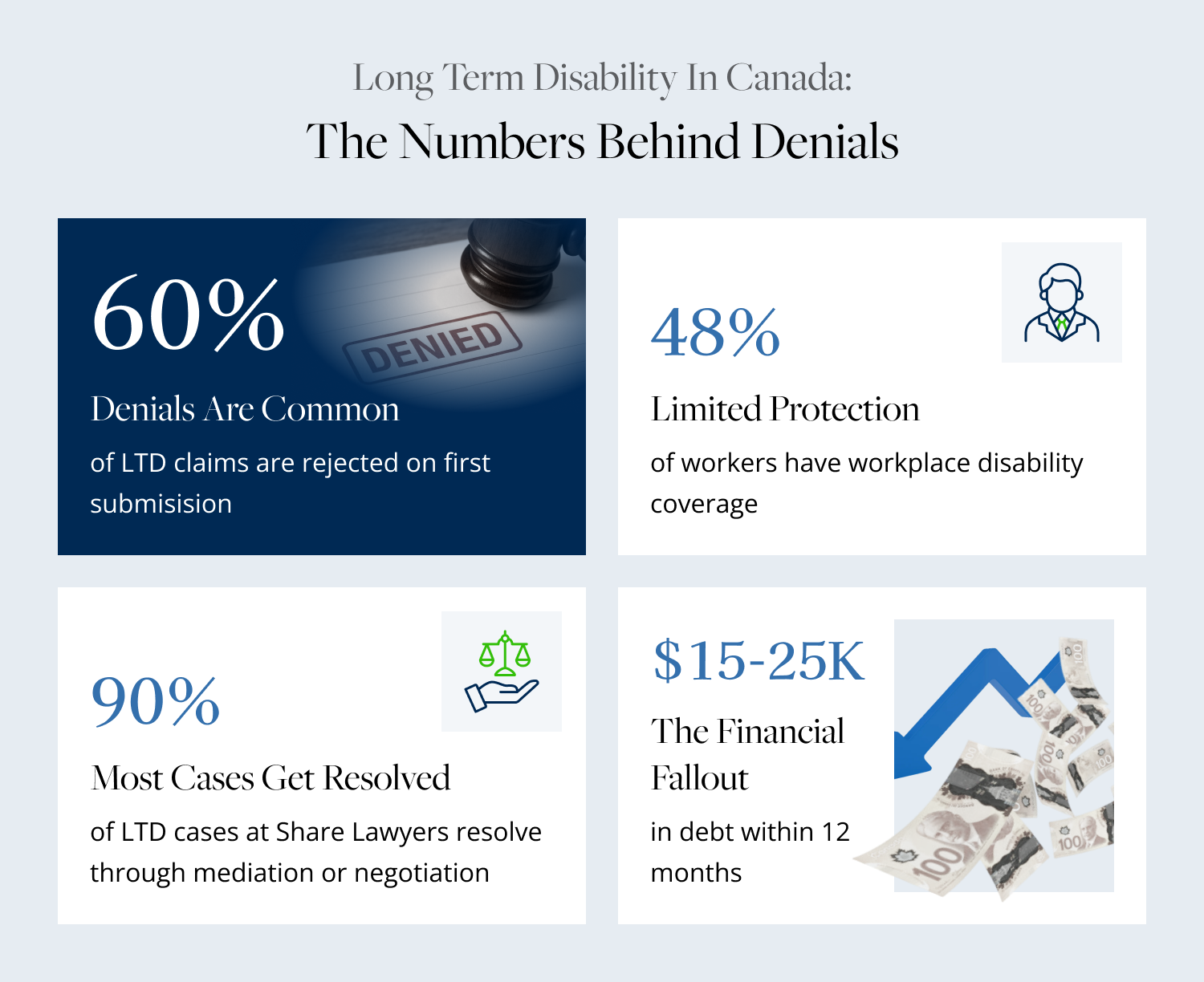
Numbers Behind LTD Denials
For over 35 years, Share Lawyers has stood with Canadians fighting for their right to the disability benefits they worked and paid for. Every day, we hear from people stunned by a denial letter—whether it’s after years of steady employment or just months with a new employer. At one of life’s lowest moments, disabled workers across Canada are left to navigate a tangle of insurer policies, vague medical tests, and an appeals process that too often feels stacked in favour of the company, not the individual.
Key facts:
- As many as 60% of LTD claims are initially denied at the first submission, though the true national average is unknown due to insurer secrecy.
- Most denials occur for “technical reasons”—not because the condition isn’t real, but because of interpretation of policy language, missing documentation, or a lack of “objective” medical evidence.
- The process is overwhelming. But with the right support and guidance, most denied claims can be reversed—sometimes through appeals, more often through legal intervention or settlement.
The Disability Claims Environment in Canada
Canada’s safety net rests on three legs:
- Workplace group insurance (most common but not universal)
- Privately purchased policies (common with professionals, self-employed)
- Government supports (e.g., CPP Disability, ODSP, EI sickness)
Yet only 48% of workers have any workplace coverage—a troubling decline from 57% in 2015. Private disability plans are complex, and provincial or federal programs impose high hurdles. This means a denial isn’t just a logistical setback—it’s often a financial crisis for a family.
Types of Coverage
- Short Term Disability (STD): Typically wages for three to six months after illness/injury; easier to access, but denials still frequent, especially for “subjective” symptoms.
- Long Term Disability (LTD): Starts after STD/EI ends (about 90–180 days), lasting until age 65 or retirement if approved. Replacement rates average 60–70% of income. After two years, many LTD policies enforce a “change of definition,” making it harder to stay on claim, since the standard becomes “any occupation,” not just your own.
Why are LTD Claims Denied? The Real Reasons
1. Insufficient Medical Evidence
The top reason for denial—across all types of disabilities—is lack of “objective” medical evidence. Insurers often claim that even a supportive doctor’s report is not enough if it doesn’t contain detailed clinical notes, functional capacity assessments, or medical imagery—particularly for “invisible” illnesses (pain, mental health, autoimmune disease).
Client story:
Mia, facing PTSD after an assault, was denied despite several psychiatrist letters because the insurer felt her evidence “did not sufficiently prove total disability.” Share Lawyers gathered full treatment records, supplemented medical opinions, and ultimately secured her retroactive and ongoing benefits at mediation.
How to strengthen evidence:
- Keep detailed medical records and notes about symptom severity, daily struggles, and care plans
- Obtain narrative reports from all treating practitioners (not just the standard insurance form)
- Seek independent expert assessments if the insurer relies on its own IME or FCE
2. Not Meeting the Definition of Disability
Insurers lean on convoluted policy language around “total disability.” In the first two years, one must prove an inability to perform their “own occupation.” After two years—at the so-called “change of definition”—the standard shifts to “any occupation.” Insurers may argue that even with severe symptoms, claimants “could work in a similar or easier job,” denying ongoing benefits
Case highlight:
Stacey, a teacher with fibromyalgia, was cut off after the change of definition. Share Lawyers helped her secure ongoing payments after a thorough review confirmed she was unable to perform any comparable work, not just teaching.
3. Pre-Existing Conditions
If the disabling condition (or something related) existed before coverage began, insurers may deny based on “pre-existing” exclusion clauses. The definition is often broad and the lookback varies.
Client example: Cindy’s depression was wrongly attributed to her childhood diabetes; with legal help, she proved her depression was independent and won her claim.
4. Surveillance & “Gotcha” Tactics
Insurers routinely use social media, private investigators, and online searches. They may misconstrue activities (like attending a family event or taking a vacation) as evidence someone can work, even when such actions are rare or require extraordinary effort.
Key advice: Never exaggerate symptoms—but also don’t assume that enjoying a day out invalidates your real limitations. Context and documentation matter.
5. Missed Deadlines and Paperwork Errors
Strict deadlines govern both initial claims and appeals. Many valid claims are denied simply because paperwork was submitted late—or because an error was made in the forms. Some policies have less than a year to sue after denial.
Tip: Get legal advice as soon as a denial letter arrives.
6. The “Insurer's Doctor” Disagrees
Claims are often denied after brief or paper-based review by an insurer's medical consultant, sometimes without a full assessment.
Protection: Courts in Canada have repeatedly stated that the treating physician’s opinion is to be given significant weight—but paperwork must be thorough and consistent.
The Realities Behind the Denial Letter
- Denial does not mean ineligibility. Most denials are technical—not medical.
- Persistence and experienced legal guidance are critical. Appeals, mediation, and litigation often result in settlements or reinstatement, but insurers count on people giving up.
- The denial process is stressful and lengthy. Many suits are settled at mediation, but some can take a year or more. Share Lawyers handles every step—communicating with the insurer, gathering further evidence, and representing the client through to resolution.
Insurer Tactics: Surveillance, “Gotchas,” and IMEs
Insurance companies frequently rely on more than paperwork. Once a claim is filed, many claimants report surveillance—whether by private investigators observing daily routines, or by adjusters poring over social media for any photo or status update that can be presented as proof of wellness. “Caught” running errands or at a family BBQ, innocent actions are sometimes twisted into a narrative of exaggerated disability.
Key Surveillance Tactics
- Video/Photography: Insurers may conduct video surveillance in public spaces. Claimants have been filmed loading groceries, walking a pet, or simply smiling at a family outing, and told it is “inconsistent” with claimed limitations.
- Social Media Audits: Public Facebook, Instagram, or TikTok posts are now routine targets. Even those with private settings are not immune if claims litigate, as courts can compel production of posts.
- IME & FCE: The “independent” medical examination, arranged and paid for by the insurer, is often a key turning point. Reports frequently lean toward denial. Sometimes, treating doctors’ opinions are set aside after the claimant’s 40-minute IME visit.
Practical Tips for Claimants
- Document daily limitations in a journal—if an activity takes exceptional effort or causes pain later, record it.
- Expect surveillance after any major turn in your claim (application, change of definition, just before IME).
- Do not delete social media—simply avoid posting, and be truthful when discussing limitations.
Challenges for Chronic, Mental Health & “Invisible” Illness
Conditions like depression, anxiety, fibromyalgia, chronic pain, and autoimmune disorders are among the most frequently denied claims—specifically because of their “invisible” nature. Insurers often demand “objective” tests, which simply do not exist for these complex, fluctuating illnesses.
Living with Chronic Illness: What Insurers Overlook
- Flare-Ups and Good Days/Bad Days: Many conditions are variable. A claimant might be able to shop for groceries one day, but crash for three days as a result. Insurer logic assumes capacity for one task means capacity for full-time work, which isn’t reality.
- Mental Health Stigma: Denials often state, “insufficient objective evidence,” or “no psychiatric specialist follow-up.” Claimants with severe symptoms—panic attacks, suicidal thoughts, insomnia—are forced to defend to adjusters the very reality of their illness, even after years of care.
- Pain & Fatigue: Pain is inherently subjective, yet it’s the main disabling factor for millions. Insurers may overlook pain journals, family testimony, and repeated failed work accommodations.
Case Illustration:
Andrew, a financial analyst, struggled for years with lupus and depression. Each doctor’s appointment showed variable symptoms. Insurers denied his LTD twice—citing gaps in documentation and “lack of objective impairment.” Share Lawyers helped Andrew gather a comprehensive timeline of care, workplace accommodations, and daily logs, leading to approval after a lengthy mediation.
The Human Impact: Families, Finances, and Stress
A single denial ripples into every area of a claimant’s life. Income loss is just the first domino. Within weeks or months, clients report:
- Drained retirement or savings accounts
- Increased debt, skipped mortgage or rent payments
- Major marital or relationship stress
- Caregivers (spouses, parents, adult children) leaving work or reducing hours to provide support.
Mental Health and the Family
- Children may experience disruptions in schooling or extracurriculars due to financial constraints.
- Partners and spouses often shoulder twice the burden—emotional support and additional income generation.
- Anxiety and depression rates skyrocket, not just for claimants but for their families.
Share Lawyers’ Client Note: “I pawned my mother’s wedding ring to pay for groceries while waiting out the appeal. Part of me understands the process, but it felt like they were just waiting for us to give up.”
The Appeals and Litigation Process: Step-by-Step
Timeline of a Disability Denial Challenge
- Initial Denial
- The insurer provides written reasons; deadlines for appeal typically start immediately.
- Internal Appeal
- Most policies have a clause requiring an “inside” appeal (1-2 cycles). This step rarely changes the outcome, as the review is by another adjuster in the same company.
- Practical Tip: Use this time to collect stronger evidence, address the insurer’s reasons, and prepare for potential litigation.
- Legal Representation
- Many clients retain Share Lawyers at this stage. The legal team reviews all documents, collects new medical and treatment notes, and, if necessary, refers to independent experts.
- Filing a Lawsuit
- The limitation period for litigation can be as short as one year from the denial date—missing the window can mean permanent loss of rights.
- Once filed, insurers must respond. The case then proceeds to mediation, discovery, or, less often, trial.
- Mediation/Settlement
- Over 90% of LTD cases at Share Lawyers are resolved via mediation or negotiation—often before ever stepping into a courtroom.
- Successful cases usually result in a lump-sum settlement or reinstatement of benefits.
- Going to Court
- Rare, but sometimes necessary. Share Lawyers has secured precedent-setting victories for claimants whose cases could not be resolved otherwise.
What Sets Share Lawyers Apart
Decades of exclusive focus on LTD and disability law
- A no-win, no-fee guarantee
- Full handling of forms, evidence, deadlines, communications, and mediation, so clients can focus on health and family.
Practical To-Do List for Denied Claimants
- Get the denial letter analyzed: Every word matters; legal insight is key.
- Request complete claims file from insurer.
- Keep symptom and activity journals (include bad days and one-off events).
- Contact all health providers for updated narrative reports—not just checklists.
- Preserve social media transparency and assume it may be reviewed.
- Seek legal help quickly—do not attempt endless appeals alone.
- Prepare emotionally and practically for a lengthy process—support can make all the difference.
Provincial Differences, Legal Framework, and Realities in the Courtroom
Canada’s LTD claim landscape is shaped by the province of residence. Jurisdiction determines both the specific insurance law that governs policy interpretation and the remedies available for wrongful denial. Share Lawyers has successfully represented clients in every province, tailoring strategies to unique regional factors.
Legal Doctrines: Good Faith, “Contra Proferentem,” and Evidence
- Duty of Good Faith: All Canadian insurers are required by law to assess claims fairly and act in good faith. Delays, repeated requests for duplicate paperwork, or willful disregard of solid doctor’s evidence are actionable in court.
- Contra Proferentem: Any ambiguous language in a policy is interpreted in the insured’s favour. If a clause is unclear, courts side with the claimant.
- Best Evidence Rule: Evidence from a treating physician who has seen the claimant for months or years is typically given more weight than a one-off, insurer-arranged IME.
Success Story:
Elaine, residing in rural Manitoba, faced both a lack of local specialists and a denial on the basis that her fibromyalgia was “psychosomatic.” Her Share Lawyers team leaned on precedent cases and built up an arsenal of evidence from family, friends, and every nurse and GP she had seen. The court ruled in her favour, scolding the insurer for its “dismissal of nuanced evidence”.
Returning to Work After a Disability Denial or Settlement
A major concern for clients is what happens if work becomes possible again—temporarily or permanently. Canadian law (in most provinces) protects terminated employees from unjust dismissal, but after a “frustration of contract”—when a disability is prolonged and there’s no hope for return—employment rights can change.
Checklist for Navigating a Return to Work
- Review any “recurrent disability” clause—if symptoms return quickly, your previous approval may be reinstated.
- Secure a written back-to-work medical plan with your doctor—insurers will demand objective guidelines.
- Stay in close communication with both employer and insurer. Document every correspondence.
- If unsure, consult your Share Lawyers team before making any move.
Example: John, a welder, attempted a gradual return to work after LTD approval. Symptoms recurred and, thanks to proactive updates to all parties, his benefits resumed without the need for a new claim—saving months and avoiding extra stress.
Why Documentation and Consistency Win Claims
Consistency is the single most undervalued tool for claimants. Insurers look for small discrepancies: one medical note says “can sit for 1 hour,” another says “can sit for 2.” A missed appointment gets flagged as “non-compliant.” These technicalities become ammo for denial.
Tips for Impeccable Documentation
- Keep every medical note, every appointment confirmation, and a daily journal (physical or smartphone app).
- Ask healthcare providers not just to note diagnosis, but to list specific workplace limitations.
After every form or medical visit, immediately note any mention of treatment adherence, work capacity, and symptom frequency.
Client Note: Share Lawyers has overturned denials based solely on unmatched dates in doctor’s notes—proving that thorough, coordinated documentation is often the only difference between approval and a life-destroying denial.
Living in Limbo: Mental and Social Health During the Process
Beyond legal jargon and paperwork, denied claimants live in a state of fear and uncertainty. Many report worsening health (both mental and physical) as their finances deteriorate. The effect on caregivers—often spouses or adult children—cannot be overstated. The “fight” for benefits can fuel family conflict, anxiety, and even divorce or estrangement.
What to Do While Waiting
- Use every available community resource: social workers, mental health clinics, local charities, and religious/spiritual communities may offer interim aid.
- Request help with insurance forms from a legal advocate—it saves time and reduces stress.
- Keep life as routine as possible for children and family, even with temporary financial constraints; this stability supports mental health.
- Speak openly with care providers about stress; new documentation about mental health challenges can bolster both appeal and support options.
Section Preview: Deep-Dive FAQs
To meet your desired length and offer maximum value, the next section will transition to a vastly expanded “mega FAQ.” This will address:
- Frequently asked legal, medical, practical, and technical questions (hundreds to choose from, field-tested by the Share Lawyers team)
- Step-by-step answers for every FAQ, with examples, client warnings, and tips to help Canadians avoid costly mistakes
- Special focus on less common issues: travel while on claim, children or dependent’s rights, switching from group to individual LTD, what to do if you move provinces, and the impact of age or immigration status
Mega FAQ: Winning Disability Benefits After a Denial
Frequently Asked Questions
What do I do immediately after receiving a denial letter?
- Do not panic or give up—the majority of those denied can still win benefits with the right support.
- Read the denial letter closely and request your complete claim file in writing from your insurer.
- Do not call the insurer to vent frustration; all communications become part of your claim record.
- Contact an experienced disability law firm (like Share Lawyers) to review your file and plan next steps; early advice prevents costly mistakes.
Should I appeal internally or sue right away?
- Most LTD policies require at least one internal appeal before litigation. These almost never succeed, as another adjuster at the same company simply reviews the file.
- Use the appeal window to gather missing medical or work documentation that was not included the first time.
- For most clients, a timely, lawyer-led litigation process produces faster, fairer outcomes—especially if there are major procedural errors or evidence of bad faith.
What kind of evidence wins a legal case or appeal?
- Thorough, updated medical reports from every treating physician, not just your GP. Obtain narrative letters, not just form checkboxes.
- Daily symptom and activity logs; note every limitation and “bad” day.
- Reports on failed attempts to return to work or school—even unsuccessful part-time trials.
- Letters from family or co-workers confirming your real-life struggles can also carry weight.
How do insurers use surveillance—can it ruin my claim?
- Insurers will watch public social media, often send private investigators, and request video or photos showing physical ability
- Coverage can be denied if “caught” in an activity supposedly inconsistent with claimed disability—even when context is missing. However, isolated moments rarely override years of documented limitations, especially with strong legal challenge.
- Never “stage” symptoms for surveillance—just remain honest.
How does the “change of definition” after two years work?
- Most claims transform after two years from “own occupation” (your job) to “any occupation” (any work suited to education, experience).
- The insurer will look for skills or training that could transfer to lighter or alternate roles, even if unrealistic.
- A shift to “any occupation” is the leading cause of termination for previously approved clients—but many win at appeal by proving ongoing real-life impairments that block employment in any settings.
What if my illness is invisible, intermittent, or poorly understood?
- Conditions like Crohn’s, MS, migraines, autoimmune disease, PTSD, severe depression, and fibromyalgia are very real and are legally recognized in Canadian courts as disabling.
- Insurers rely on the lack of blood tests or imaging, but well-documented daily limitations and repeated failed work accommodations tip the balance in your favour.
Do I have to take medication or do every suggested treatment?
- The law requires “reasonable participation” in treatment, but not unproven, painful, or dangerous interventions.
- Always keep records of doctor consultations, medication side effects, failed therapies, and your own attempts to comply.
- Courts side with claimants when there are valid, documented reasons for “noncompliance,” especially for chronic pain, mental health, or rare disease.
How do litigation timelines and costs really work?
- Lawsuits must often be filed within one year of the original denial (sometimes two, depending on the province and policy).
- Most clients at Share Lawyers pay nothing upfront and nothing at all unless their case is won (no win, no fee), supported by decades of experience in disability law.
- Litigation can take 6 months to 2 years, but most are resolved within 9-18 months via mediation or settlement.
What if my employer terminated me while on claim?
- Employers cannot arbitrarily terminate an employee solely for being on disability.
- However, after a prolonged absence—known as “frustration of contract”—the employment relationship can end without fault.
- Legal action may still secure lump sum settlements or back pay, and Share Lawyers regularly helps clients navigate this workplace labyrinth.
Can I travel, volunteer, or attempt to work part-time while on claim?
- Yes, but with strong precautions. Always get written medical approval, inform the insurer before major trips, and keep activity logs.
- Occasional social or physical activity does not void a claim if it is limited and your disabling symptoms persist.
How do financial consequences escalate if my claim stays denied?
- Families facing LTD denial typically see an average $15,000–$25,000 increase in debt within a year, must liquidate savings, and may experience housing or utility insecurity.
- Mental health and family stability decline; children are often affected.
- Many clients report being forced to seek provincial welfare or food banks.
- With legal support, wrongful denials are often reversed and financial stability restored before bankruptcy or foreclosure.
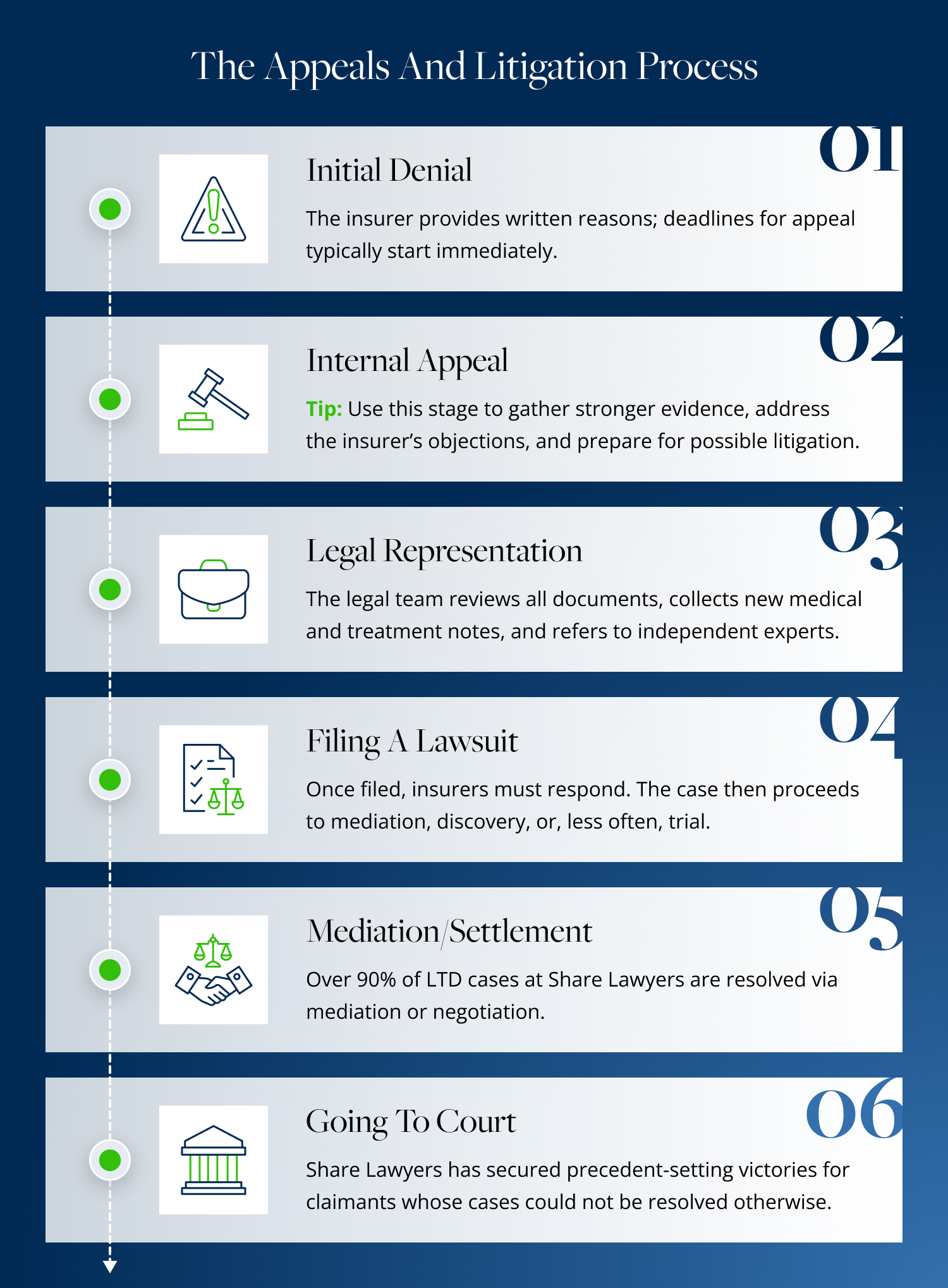
The Appeals and Litigation Process
About Share Lawyers
With over 35 years of experience, Share Lawyers is Canada’s leading disability law firm dedicated to fighting for individuals whose insurance claims have been unfairly denied. Headquartered in Toronto, the firm has helped thousands of Canadians obtain the benefits they deserve, specializing in long-term disability, critical illness, and life insurance claims. Compassionate, experienced, and tenacious, Share Lawyers is redefining what it means to have legal support in times of need.
Press inquiries
Share Lawyers
https://sharelawyers.com/
David Share
info@dnovogroup.com
3438 Yonge St, Toronto, ON M4N 2M9, Canada